
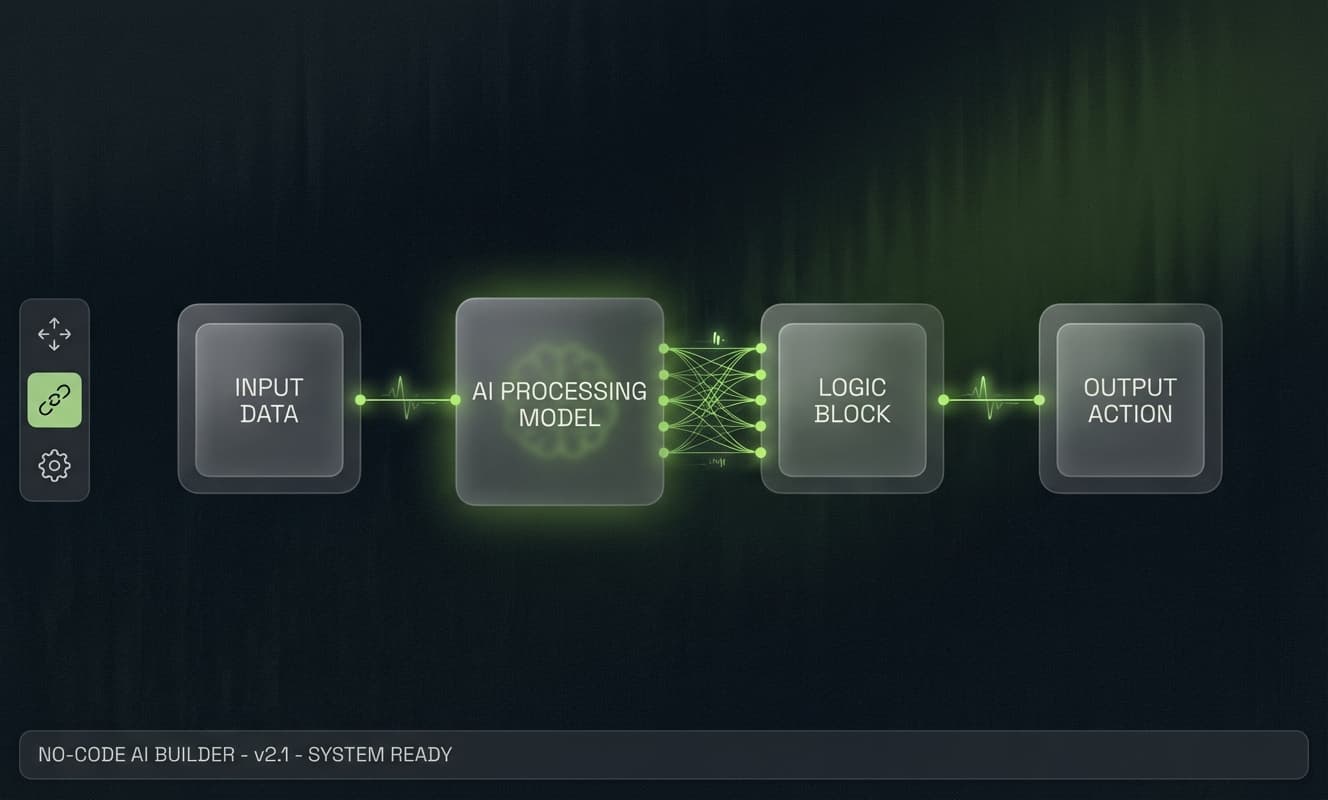
No-code AI agents let you build autonomous software without writing code. 14 platforms compared across three categories: app builders, workflow automators, and agent platforms. Comparison table first, deep dives after.
Platform Comparison
| Platform | Type | Pricing | Best For |
|---|---|---|---|
| Lovable | App Builder | Free / $20-100/mo | Full-stack React apps from prompts |
| Bolt | App Builder | Free / $25-30/mo | Multi-framework apps (React, Vue, Svelte) |
| Replit Agent | App Builder | Free / $20/mo + usage | Full-stack with built-in hosting & 30+ integrations |
| v0 (Vercel) | App Builder | Free / $20-30/mo | Next.js/Vercel teams, UI component generation |
| n8n | Workflow Automator | Free self-hosted / $24/mo cloud | AI workflow automation, 400+ integrations |
| Make | Workflow Automator | $9/mo+ | Visual multi-step agent workflows |
| Zapier | Workflow Automator | Free / $20/mo+ | Simplest setup, 7,000+ app integrations |
| Dify | Agent Platform | Free self-hosted / $59/mo cloud | Production AI agents with RAG and workflows |
| Langflow | Agent Platform | Free (open source) | Visual agent builder, Python extensible |
| Lindy | Agent Platform | $30/mo+ | Pre-built agent templates, 4,000+ integrations |
| MindStudio | Agent Platform | Free / usage-based | 100+ templates, no markup on model costs |
| Gumloop | Agent Platform | Free / $37/mo+ | Zapier-like UX for AI agents |
| Botpress | Agent Platform | Free tier / usage-based | Conversational AI agents and chatbots |
| Stack AI | Agent Platform | Free tier / $199/mo+ | Enterprise workflows, SOC 2 compliant |
What Is a No-Code AI Agent
A no-code AI agent is autonomous software that takes actions, makes decisions, and integrates with external services, built entirely through visual interfaces instead of code. Unlike simple chatbots that only respond to messages, agents can use tools, maintain memory, execute multi-step plans, and trigger actions in third-party services.
The market split into three distinct categories in 2026:
App Builders
Generate full-stack applications from natural language prompts. Lovable, Bolt, Replit Agent, and v0 handle frontend, backend, database, auth, and deployment. These are vibe coding tools for non-developers.
Workflow Automators
Chain AI into existing business processes. n8n, Make, and Zapier add AI nodes (LLM calls, RAG, classification) into automation flows that connect hundreds of services.
Agent Platforms
Build standalone AI workers with memory, tool use, and multi-step reasoning. Dify, Langflow, Lindy, and MindStudio create agents that operate independently on defined tasks.
"No-code" means visual-only, no programming required. "Low-code" means mostly visual but allows custom code at the edges. Most platforms in this guide are technically low-code: n8n lets you write JavaScript inside nodes, Langflow exposes Python per-component, Dify has code sandbox blocks. The distinction matters when you hit the limits of visual building.
App Builders: Full Applications from Prompts
These tools turn natural language descriptions into working applications. They overlap heavily with vibe coding tools and the vibe coding movement. The difference from traditional no-code (Bubble, Webflow) is that you describe what you want and an AI agent builds it, rather than dragging components manually.
Lovable
Lovable generates full-stack React applications from conversational prompts. It understands React patterns deeply and produces clean, maintainable code. $20/month (Starter) to $100/month (Scale). Strong for developers who want to export and own the generated code. Weaker for non-technical founders who need something that just works without touching code at all.
Bolt
Bolt positions itself as "prompt to full-stack app" in the browser. It supports more frameworks than Lovable: React, Vue, Svelte, and others. Free tier with 1M tokens/month, Pro at $25/month with 10M tokens. The in-browser development experience is smoother than most competitors. Token-based pricing means costs scale with project complexity.
Replit Agent
Replit Agent 3 is now a full-stack platform with built-in database, authentication, hosting, and 30+ integrations including Stripe, Figma, Notion, and Salesforce. $20/month (Core) plus usage charges for compute and deployment. The all-in-one approach means you never leave the platform, but actual costs can add up beyond the base subscription.
v0 by Vercel
v0 generates components rather than complete applications. You get beautiful UI pieces that you integrate into your own Next.js codebase. Free tier with $5 in credits, Pro at $20/user/month. Best for teams already on Vercel who want AI-generated frontend components, not for people building entire apps from scratch.
Workflow Automators: AI Inside Business Processes
These platforms are not just AI tools. They are general automation platforms that added AI capabilities. The value is in connecting AI to the hundreds of services your business already uses.
n8n
n8n is the standout in this category with 176K+ GitHub stars, making it one of the most popular open-source projects on the platform. Its AI Workflow Builder lets you describe workflows in plain English, and the node-based editor supports 400+ integrations. Free self-hosted with unlimited executions, or cloud starting at $24/month (2,500 executions).
The developer community treats n8n as the de facto "action layer" for AI agents. You build the reasoning in one tool (or directly in n8n) and use n8n to connect it to Slack, email, databases, APIs, and everything else. Self-hosting means your data never leaves your infrastructure.
Make
Make shipped AI agent support directly into its visual scenario builder in February 2026. Multi-step agent workflows with conditional branching work well for structured processes. $9/month (Core) to $16/month (Pro). Less agentic flexibility than n8n, but a polished UI that non-technical users find easier to learn.
Zapier
Zapier remains the most beginner-friendly option with 7,000+ app integrations. Its AI agent builder uses plain-language prompts. The limitation: Zapier's architecture is fundamentally linear. Conditional branching requires paid features (Paths, Code by Zapier). Free tier available, paid plans from $20/month.
n8n and Dify both offer free self-hosted editions with no execution limits. For teams with sensitive data or compliance requirements, self-hosting keeps everything on your infrastructure. Cloud editions trade control for convenience, with n8n Cloud starting at $24/month and Dify Cloud at $59/month.
Agent Platforms: Standalone AI Workers
These platforms focus specifically on building AI agents, not general apps or workflow automations. They give agents memory, tool access, RAG pipelines, and multi-step reasoning out of the box.
Dify
Dify is an open-source platform with 130K+ GitHub stars, placing it in the top 100 open-source projects globally. It provides a visual drag-and-drop interface for building agentic workflows with built-in RAG pipelines, support for 100+ LLM providers, and an observability dashboard. Free self-hosted, cloud from $59/month (Professional).
Dify removed LangChain from its codebase and built a concise set of 15 components that cover most use cases. The component count is intentionally small: fewer parts to learn, more combinations possible. Free for students and educators.
Langflow
Langflow hit 100K GitHub stars in August 2025 and continues growing. It provides a visual canvas for building agents and RAG applications with a live chat pane for testing while you build. Completely free and open source.
Langflow's differentiator: you can modify each component's Python code to change its behavior, while other platforms restrict custom code to sandbox environments. This makes it the best bridge between no-code and code-first development.
Lindy
Lindy focuses on pre-built agent templates with 4,000+ integrations. It targets business users who want agents for sales, customer support, and internal operations. $30/month per agent. The template-first approach means faster time to value, but less flexibility for custom workflows.
MindStudio
MindStudio offers 100+ templates with transparent usage-based pricing: no markup on AI model costs. You pay exactly what providers charge. Free plan includes 2 agents and 1,000 runs/month. Good for teams that want predictable costs and hate credit systems.
Gumloop
Gumloop takes a Zapier-like approach to agent building. Visual interface, credit-based pricing. Free tier with 2,000 credits, Solo from $37/month (10,000 credits). Supports bringing your own API key to reduce costs. Teams plan at $244/month scales to 10 seats.
No-Code vs Code-Based Agents
The choice is not binary. Most teams use both. The question is which tool fits which problem.
| Scenario | No-Code | Code-Based |
|---|---|---|
| MVP / prototype | Best choice. Ship in hours, not weeks. | Overkill unless you need custom logic from day one. |
| Internal tools | Great. Customer support bots, lead qual, data pipelines. | Only if integrating deeply custom systems. |
| Content workflows | Strong. Summarization, classification, extraction. | Unnecessary for standard content ops. |
| Production systems | Risky. Vendor lock-in, scaling limits, debugging opacity. | Right choice. Full control, testable, deployable. |
| Complex business logic | Breaks down. Visual builders lack algorithmic depth. | Required. Custom routing, error handling, edge cases. |
| Model routing | Limited. Most platforms lock you to their model choices. | Full flexibility. Route by task type, cost, speed. |
| Security-critical | Depends on platform's compliance. Data leaves your infra. | Self-hosted, auditable, fully controlled. |
Code-based agents like Claude Code, Cursor, and Cline give developers full control over model selection, prompt engineering, error handling, and deployment. No-code agents trade that control for speed and accessibility. The strongest workflows combine both: prototype in no-code, validate the concept, then rebuild critical paths in code for production.
Limitations of No-Code AI Agents
Complex Logic Ceiling
Visual builders handle linear and branching flows well. They struggle with nested conditionals, recursive logic, custom algorithms, and nuanced decision trees. If your agent needs to do something the platform didn't anticipate, you hit a wall.
Vendor Lock-In
Workflows built on proprietary platforms can't easily migrate. If Lindy or Gumloop changes pricing or shuts down, your agents go with them. Open-source options (Dify, Langflow, n8n) mitigate this by letting you self-host.
Scaling Constraints
Credit-based and execution-based pricing means costs grow linearly with usage. High-volume production workloads can become expensive fast. Self-hosted options avoid per-execution fees but require infrastructure management.
Debugging Opacity
When an agent fails in a visual builder, tracing the root cause is harder than in code. You can't set breakpoints, add logging, or step through execution the way you can with a code-based agent.
The most common failure pattern: a team builds an agent in a no-code tool, it works for the demo, and then they try to scale it to production. The platform's constraints become bottlenecks. The fix is intentional: use no-code to validate the concept quickly, then invest in a code-based rebuild for the parts that need to scale. Not everything needs to migrate. Keep the simple workflows in no-code and build the critical path in code.
Frequently Asked Questions
What is a no-code AI agent?
A no-code AI agent is autonomous software you build without writing code. It can take actions, make decisions, use external tools, and maintain memory across conversations. Platforms like Dify, n8n, and Lindy provide visual builders where you connect components instead of writing logic by hand.
What is the best no-code AI agent platform in 2026?
Depends on your use case. For full apps from prompts: Lovable or Replit Agent. For business workflow automation: n8n (176K GitHub stars, free self-hosted) or Make. For standalone AI agents with memory and tool use: Dify (130K GitHub stars, free self-hosted) or Langflow. For the simplest setup with most integrations: Zapier.
Are no-code AI agent builders free?
Several have meaningful free tiers. Dify and Langflow are fully open source and free to self-host. n8n is free self-hosted with unlimited executions. MindStudio offers a free plan with 1,000 runs/month. Lovable, Bolt, and Replit have free tiers with limited usage. You still pay for LLM API calls on most platforms.
What are the limitations of no-code AI agents?
Four constraints: complex decision logic beyond what visual builders support, vendor lock-in on proprietary platforms, scaling limits tied to execution-based pricing, and debugging opacity when agents fail. Production systems with deeply custom business logic typically outgrow no-code tools.
When should I use no-code vs code-based agents?
Use no-code for MVPs, internal tools, customer support bots, lead qualification, and content workflows where speed matters more than customization. Use code-based agents for production systems, complex integrations, performance-critical applications, and custom model routing.
Can no-code AI agents replace developers?
No. They reduce the need for developers on routine tasks and let non-technical teams build simple automations. Complex business logic, production reliability, security, and custom integrations still require engineering. The most effective teams use no-code for prototyping and code for production.
When Your Agent Needs to Apply Code
Whether you build agents visually or in code, they all face the same problem: merging LLM output into real files. Morph's Fast Apply model handles deterministic code merges at 10,500+ tokens per second. Try it in the playground or integrate via API.