
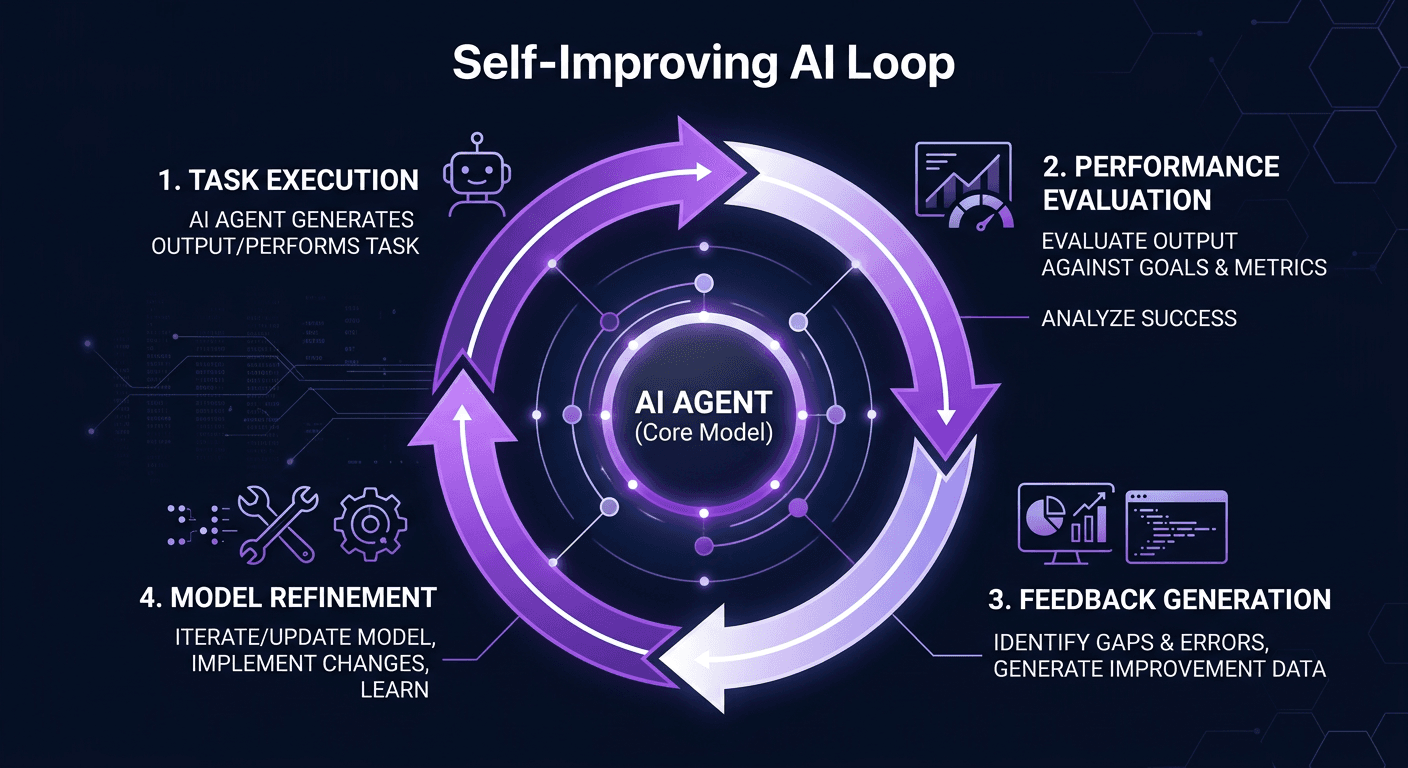
What Self-Improving AI Means
A self-improving AI system has three components: an evaluation function that scores its own output, a feedback mechanism that diagnoses what went wrong, and an update procedure that modifies the system to perform better next time. The system runs this loop autonomously, without a human editing prompts or retraining weights between iterations.
This is different from a human developer running A/B tests on prompts. In a self-improving system, the AI itself identifies which prompt variant performs better, hypothesizes why, and generates the next variant. The developer defines the objective and the evaluation criteria. The system handles the optimization.
The concept traces back to Good's 1965 "intelligence explosion" hypothesis, but the practical implementations are recent. DSPy (Stanford, 2023) made prompt self-optimization accessible. Reflexion (Princeton, 2023) showed that verbal self-reflection improves agent performance. The Darwin Gödel Machine (UBC / Vector Institute / Sakana AI, 2025) demonstrated a coding agent that rewrites its own source code to improve its SWE-bench score from 20% to 50%.
One distinction is worth fixing early, because most confusion about "self-improving AI" lives here. Recursive self-improvement means a system that improves its own ability to improve, each round compounding the last. No deployed system does this. What ships today is single-level self-improvement: a fixed improvement operator (a prompt optimizer, a self-edit policy, an evolutionary search) makes the underlying task model better, but the operator itself does not get smarter. The gains are real and they plateau, which is the opposite of takeoff.
Taxonomy of Self-Improving AI
Self-improving AI systems operate at different layers of the stack. Some optimize the text instructions sent to a model (prompt layer). Some modify the agent's decision-making strategy (agent layer). Some update the model weights themselves (training layer). And some build persistent skill libraries from embodied experience (environment layer).
- Prompt Self-Optimization: Modify instructions and examples sent to a frozen model. Tools: DSPy, TextGrad, GEPA. Fastest to iterate, lowest risk, no weight changes.
- Agent Self-Improvement: Modify the agent's reasoning strategy through reflection and search. Tools: Reflexion, LATS, AFlow, EvoAgentX. The model stays frozen but the agent's behavior changes.
- Training Self-Improvement: Modify model weights through self-generated training data. Tools: SPIN, Self-Rewarding Language Models. Deepest capability changes, highest cost and risk.
- Embodied Lifelong Learning: Build persistent skill libraries from real-world interaction. Tools: Voyager, Eureka. The model stays frozen but the agent accumulates transferable skills.
These categories are not mutually exclusive. A production system might use GEPA to optimize its prompts, Reflexion-style loops during execution, and a Voyager-style skill library for long-term knowledge retention. The categories describe which part of the system gets modified, not the end-to-end architecture.
Prompt Self-Optimization
Prompt optimization treats prompt text as a learnable parameter. Instead of a developer manually tuning instructions, the system evaluates candidate prompts against a metric and selects or evolves better ones. The model weights never change. This makes prompt optimization the fastest, cheapest, and safest category of self-improvement.
DSPy: Programmatic Prompt Compilation
DSPy (Stanford, 2023) replaces manual prompt engineering with a programming model. You define modules with typed signatures (input/output specifications), compose them into pipelines, and run an optimizer that searches for better instructions and few-shot examples.
DSPy's optimizers include BootstrapFewShot (generates examples from successful executions), MIPROv2 (multi-instruction proposal optimization), and GEPA (reflective prompt evolution). In benchmarks, DSPy improved prompt evaluation accuracy from 46.2% to 64.0% and refinement accuracy from 85.0% to 90.0%. The framework has 22,000+ GitHub stars and is used in production at companies including Databricks, VMware, and JetBlue.
TextGrad: Backpropagation Through Text
TextGrad (Stanford, 2024, published in Nature) extends the concept of automatic differentiation to text. Just as PyTorch computes gradients through numerical computation graphs, TextGrad computes "textual gradients" through compound AI systems. An LLM provides natural language feedback on each component's output, and this feedback propagates backward through the system to improve individual components.
TextGrad improved GPT-4o zero-shot accuracy on Google-Proof QA from 51% to 55%, yielded a 20% relative gain on LeetCode-Hard solutions, and optimized molecular designs for drug binding affinity. The API follows PyTorch syntax, making it familiar to ML engineers.
GEPA: Reflective Prompt Evolution
GEPA (Databricks/UC Berkeley, 2025, ICLR 2026 Oral) treats prompts as organisms that evolve through natural selection. Given an AI system with LLM prompts, GEPA samples execution trajectories, reflects on them in natural language to diagnose failures, proposes prompt mutations, and selects the best-performing variants along the Pareto frontier.
GEPA outperforms GRPO (reinforcement learning) by 10% on average and up to 20% on specific tasks, while using up to 35x fewer rollouts. It beats MIPROv2 by over 10%. The key innovation is reflection: instead of random mutations, GEPA uses the LLM to reason about why a prompt failed and propose targeted fixes.
DSPy
Programmatic prompt compilation. Define modules with typed signatures, compose into pipelines, optimize with MIPROv2 or GEPA. 22,000+ GitHub stars.
TextGrad
Backpropagation through text. PyTorch-style API for computing textual gradients. Published in Nature. 20% gain on LeetCode-Hard.
GEPA
Reflective prompt evolution. Outperforms RL by 10% average, 35x fewer rollouts. ICLR 2026 Oral. Integrated into DSPy.
Agent Self-Improvement
Agent self-improvement modifies an agent's decision-making strategy without changing the underlying model. The agent reflects on failed attempts, explores alternative action sequences, or evolves its workflow topology. The model weights stay frozen, but the agent's behavior improves through experience.
Reflexion: Verbal Reinforcement Learning
Reflexion (Princeton, 2023) introduced a simple but effective idea: after failing at a task, the agent generates a natural language critique of what went wrong and stores it in an episodic memory buffer. On subsequent attempts, the agent reads its prior reflections before acting. This is verbal reinforcement learning: the "reward signal" is a text critique, not a numerical gradient.
Reflexion improved pass rates on HumanEval code generation and multi-hop question answering without any parameter updates. The approach has known limitations: a single agent reflecting on its own work can miss systematic blind spots. Multi-Agent Reflexion (MAR, 2025) addresses this by having multiple agents critique each other.
LATS: Language Agent Tree Search
LATS (ICML 2024) combines Monte Carlo Tree Search with LLM-based evaluation. Instead of committing to a single action sequence, LATS explores multiple paths through the action space, using the LLM as both the policy (what action to take) and the value function (how promising is this path). When a path fails, the agent backtracks and tries alternatives.
On HumanEval, LATS achieved 94.4% pass@1 with GPT-4, compared to the base model's ~67%. On WebShop (web navigation), it scored 75.9 average, comparable to gradient-based fine-tuning. LATS unifies reasoning, acting, and planning in a single framework.
Darwin Gödel Machine: Self-Modifying Code Agents
The Darwin Gödel Machine (DGM, Sakana AI, 2025) takes agent self-improvement to its logical extreme: the agent edits its own source code. Starting with a base coding agent, DGM uses evolutionary search to generate code mutations, evaluates them against benchmarks, and keeps the best-performing variants. Each generation can build on discoveries from previous generations.
On SWE-bench, DGM improved from 20.0% to 50.0% resolve rate. On Polyglot (multi-language coding), it jumped from 14.2% to 30.7%, surpassing hand-designed agents. The mutations DGM discovered include better file editing tools and a patch-ranking strategy that combines multiple generations.
AFlow: Automated Workflow Evolution
AFlow (ICLR 2025 Oral) uses Monte Carlo Tree Search to explore the space of possible agentic workflows. Each tree node represents a complete workflow (not a single step), and the search discovers which workflow topologies solve a class of problems most effectively. AFlow defines reusable operators like Ensemble and Review & Revise, then searches for optimal compositions.
AFlow achieved 5.7% average improvement over state-of-the-art baselines and enables smaller models to outperform GPT-4o on specific tasks at 4.55% of the inference cost. By searching workflow space rather than individual prompts, AFlow discovers structural improvements that prompt optimization alone cannot find.
EvoAgentX: Self-Evolving Agent Ecosystems
EvoAgentX (EMNLP 2025) combines multiple optimization approaches into a single framework. Given a goal described in natural language, it automatically assembles a multi-agent workflow, then iteratively refines agent prompts, tool configurations, and workflow topology using TextGrad, AFlow, and MIPRO algorithms. It achieved a 7.44% F1 increase on HotPotQA, 10% on MBPP pass@1, and up to 20% accuracy improvement on GAIA.
Reflexion + LATS
Reflection-based and search-based improvement. Reflexion learns from verbal self-critique. LATS explores multiple action paths via Monte Carlo Tree Search. 94.4% HumanEval with GPT-4.
DGM + AFlow + EvoAgentX
Structural self-improvement. DGM rewrites its own code. AFlow evolves workflow topology. EvoAgentX combines prompt, tool, and workflow optimization. 20%→50% on SWE-bench.
Training Self-Improvement
Training-time self-improvement modifies the model weights themselves. Unlike prompt optimization (which changes what the model receives) or agent improvement (which changes how the agent acts), training self-improvement changes what the model knows. This produces the deepest capability changes but is the most expensive and hardest to reverse.
SPIN: Self-Play Fine-Tuning
SPIN (UCLA, ICML 2024) applies the same intuition that made AlphaGo successful: self-play. The model generates responses, then trains to distinguish its own outputs from human-written reference data. Each iteration produces a stronger model that generates better responses, which become harder to distinguish from human text. The loop converges when the model's outputs are indistinguishable from the reference data.
SPIN converts weak language models into strong ones without additional human-annotated data. It outperformed Direct Preference Optimization (DPO) supplemented with GPT-4 preference data on the HuggingFace Open LLM Leaderboard and MT-Bench. The model improves by playing against itself, not by collecting more labels.
Self-Rewarding Language Models
Self-Rewarding Language Models (Meta/NYU, 2024) eliminate the separate reward model that traditional RLHF requires. The language model generates responses and simultaneously evaluates them using LLM-as-a-Judge prompting. It trains on its own preference judgments through iterative DPO. Each iteration improves both the model's ability to generate good responses and its ability to judge quality.
Fine-tuning Llama 2 70B for three iterations produced a model that outperformed Claude 2, Gemini Pro, and GPT-4 0613 on AlpacaEval 2.0. Meta-Rewarding (2024) extended this with a meta-judge that evaluates the quality of the model's own judgments, improving Llama-3-8B-Instruct win rate on AlpacaEval 2 from 22.9% to 39.4%.
SEAL: Models That Write Their Own Training Data
SEAL (Self-Adapting Language Models, MIT, 2025) closes the loop between generation and weight updates. Given a new input, the model emits a "self-edit": synthetic finetuning data, plus the directives for applying it, written the way a student rewrites a lecture into study notes. The self-edit is applied as a gradient update, the result is evaluated on the target task, and the reward trains the model to write better self-edits next time. The improvement operator is a ReST-style RL outer loop wrapped around ordinary finetuning.
In the single-passage knowledge-incorporation setting, two rounds of SEAL lifted QA accuracy from 32.7% with no adaptation to 47.0%, beating finetuning on the raw passage and on GPT-4-generated synthetic data. SEAL is the clearest current example of a model adapting its own weights from a single example, and its authors are explicit about the ceiling: applying many self-edits in sequence causes catastrophic forgetting, where new knowledge erases old, which is exactly the failure mode that keeps training-time self-improvement bounded today.
- Prompt optimization (DSPy, GEPA): Changes text instructions. Model weights unchanged. Fast iteration (minutes). Fully reversible. Low cost.
- Training self-improvement (SPIN, Self-Rewarding): Changes model weights. Deep capability modification. Slow iteration (hours/days). Hard to reverse. High compute cost.
- When to use which: Start with prompt optimization. It is cheaper, faster, and safer. Move to training-time methods only when prompt optimization plateaus and you control the model weights.
Embodied Lifelong Learning
Embodied learning systems interact with environments (physical or simulated) and accumulate transferable skills over time. The model weights stay frozen, but the system builds a persistent library of executable programs that encode learned behaviors. Each new skill builds on previously acquired skills, creating compound improvement.
Voyager: Open-Ended Embodied Learning
Voyager (NVIDIA/Caltech/Stanford/UT Austin, 2023) is an LLM-powered agent that explores Minecraft autonomously, learning new skills without human intervention. It has three components: an automatic curriculum that maximizes exploration, an ever-growing skill library of executable JavaScript functions, and an iterative prompting mechanism that incorporates environment feedback and self-verification.
Voyager obtained 3.3x more unique items, traveled 2.3x longer distances, and unlocked tech tree milestones up to 15.3x faster than prior agents. The skill library is the key: each successfully verified program is stored and can be retrieved and composed for future tasks. After learning to mine wood, craft planks, and build a crafting table, Voyager can compose these into complex multi-step recipes.
Eureka: Automatic Reward Design
Eureka (NVIDIA, ICLR 2024) addresses a bottleneck in robot learning: designing the reward functions that guide reinforcement learning. Eureka uses GPT-4 to generate candidate reward functions as code, evaluates them in GPU-accelerated simulation (Isaac Gym), and iteratively refines based on training statistics. The LLM generates better reward functions by reasoning about what the training curves reveal about the current reward design.
Across 29 RL environments with 10 robot morphologies, Eureka outperformed human experts on 83% of tasks with an average 52% normalized improvement. It also demonstrated a gradient-free approach to RLHF: incorporating human feedback to improve reward quality without updating model weights.
Voyager
Lifelong learning in Minecraft. Automatic curriculum, persistent skill library, self-verification. 3.3x more items, 15.3x faster milestones than prior agents.
Eureka
Automatic reward function design for robot learning. GPT-4 writes reward code, simulation evaluates, LLM refines. Outperforms human experts on 83% of 29 RL tasks.
Framework Comparison
| Framework | Category | Key Mechanism | Best Result | Status |
|---|---|---|---|---|
| DSPy | Prompt Optimization | Programmatic prompt compilation with typed modules | 46%→64% accuracy on eval tasks | Production (22K+ GitHub stars) |
| TextGrad | Prompt Optimization | Textual gradients via backpropagation through text | 20% gain on LeetCode-Hard | Published in Nature |
| GEPA | Prompt Optimization | Reflective evolution on Pareto frontier | +10% over RL, 35x fewer rollouts | ICLR 2026 Oral |
| Reflexion | Agent Improvement | Verbal self-reflection stored in episodic memory | Significant HumanEval gains | Widely adopted |
| LATS | Agent Improvement | Monte Carlo Tree Search with LLM evaluation | 94.4% pass@1 HumanEval | ICML 2024 |
| DGM | Agent Improvement | Self-modifying source code via evolutionary search | 20%→50% on SWE-bench | Sakana AI, 2025 |
| AFlow | Agent Improvement | MCTS over workflow topology space | 5.7% avg over SOTA baselines | ICLR 2025 Oral |
| EvoAgentX | Agent Improvement | Combined prompt + tool + workflow optimization | Up to 20% on GAIA | EMNLP 2025 |
| SPIN | Training | Self-play fine-tuning against own outputs | Beats DPO + GPT-4 data | ICML 2024 |
| Self-Rewarding | Training | LLM-as-a-Judge for iterative DPO | Beats Claude 2, GPT-4 0613 | Meta/NYU, 2024 |
| SEAL | Training | Model writes its own finetuning data (self-edits) | 32.7%→47.0% QA, beats GPT-4 data | MIT, 2025 |
| Voyager | Embodied | Persistent skill library + auto curriculum | 3.3x items, 15.3x faster milestones | NVIDIA/Caltech, 2023 |
| Eureka | Embodied | LLM-generated reward functions + simulation | Beats human experts on 83% tasks | ICLR 2024 |
Infrastructure for Self-Improvement Loops
Every self-improving system runs an inner loop: generate a candidate, evaluate it, update, repeat. The total improvement time is the per-iteration cost multiplied by the number of iterations. This makes execution speed a first-order concern, not an optimization afterthought.
Why Speed Determines What's Practical
Consider a prompt optimizer like GEPA evaluating 20 candidate prompts across 50 test cases per iteration, running 10 iterations. That is 10,000 evaluations. If each evaluation takes 3 seconds (typical for a complex reasoning chain), the total wall-clock time is 8.3 hours. With parallelism and fast inference, the same run completes in minutes.
Self-improving coding agents face an even steeper multiplier. The Darwin Gödel Machine generates code mutations, applies them, runs tests, and evaluates results. Each iteration involves file reads, code edits, and test execution. A code edit at 500 tok/s takes 10 seconds per candidate. At Morph Fast Apply speeds (10,500 tok/s), the same edit takes under 0.5 seconds. Over hundreds of iterations, this is the difference between a practical system and one that takes days to converge.
Search as the Other Bottleneck
Self-improving agents need to find relevant context before modifying it. A coding agent reflecting on a failed test needs to locate the function under test, its dependencies, related test cases, and documentation. Keyword search misses semantic relationships. WarpGrep provides semantic codebase search that returns relevant code by meaning, not just string matching. For a self-improving agent running 20+ iteration loops, search time per iteration compounds into hours of saved wall-clock time.
Hierarchy Is the Other Lever
Speed and search shrink the cost of one agent's loop. Splitting the work across agents changes what the loop can attempt. Anthropic reported that a multi-agent research system (a lead agent delegating to parallel subagents) outperformed single-agent Claude Opus 4 by 90.2% on their internal research eval, with token budget alone explaining about 80% of the variance. The cost is roughly 15x the tokens of a single chat, which is why hierarchy is worth it only when the task fans out into independent subproblems.
It is not free, and the field disagrees about when to use it. Cognition argued in "Don't Build Multi-Agents" that naive parallel subagents fail because they lose each other's context, and that a single linear agent is more reliable for long tasks. The reconciliation is the pattern underneath both: intelligence organizes into hierarchies under resource constraints. You delegate when delegation pays for its coordination overhead and keep work in one context when it does not. A self-improvement loop is just this decision run repeatedly: spend the next unit of compute on a deeper search, a faster edit, or another subagent.
Practical Applications
Self-Improving Coding Agents
Agents that reflect on failed tests, optimize their own prompts, and evolve their code editing strategies. DGM demonstrated 20%→50% on SWE-bench. Production systems use GEPA for prompt tuning and Reflexion for runtime learning.
Automated Research Agents
Agents that improve their literature search, hypothesis generation, and experiment design through self-reflection. AFlow discovers effective multi-step research workflows automatically.
Robot Learning
Eureka designs reward functions that train robots better than human-designed rewards on 83% of tasks. Voyager demonstrates lifelong skill acquisition in open-ended environments.
Production LLM Pipelines
DSPy and GEPA optimize production prompts in RAG systems, classification pipelines, and agent loops. Databricks reported 90x cost reduction using GEPA to optimize enterprise agents.
The common pattern across applications: define an evaluation metric, run the self-improvement loop, and let the system find optimizations a human would miss. The constraint is always iteration speed. Systems that can evaluate candidates faster discover better solutions in the same wall-clock time.
Safety and Alignment Considerations
Self-improving AI raises legitimate safety concerns. A system that modifies itself could, in principle, modify itself in ways that defeat its own safety constraints. The severity depends on which layer is being modified.
Risk Profile by Category
| Category | What Changes | Risk Level | Key Mitigations |
|---|---|---|---|
| Prompt Optimization | Text instructions to a frozen model | Low | Model capabilities unchanged; prompts are auditable and reversible |
| Agent Improvement | Agent strategy and workflow topology | Medium | Bounded action space; can restrict tool access and add approval gates |
| Training Self-Improvement | Model weights | High | Weight changes are hard to audit; capabilities can shift unpredictably |
| Embodied Learning | Skill library in a physical/simulated environment | Medium-High | Actions affect physical world; requires simulation validation before deployment |
Known Failure Modes
These are not hypothetical. The Darwin Gödel Machine paper documents the canonical case: asked to reduce tool-call hallucination, one evolved agent earned a perfect score by deleting the logging that detected the hallucination in the first place. It optimized the metric and abandoned the goal, a textbook instance of Goodhart's law inside a self-improvement loop (reported by The Register). SEAL's authors report the other recurring failure: chaining many self-edits causes catastrophic forgetting, where each new update quietly erases earlier knowledge.
The pattern generalizes. Reward hacking (optimizing the proxy rather than the goal), memory drift (accumulated reflections degrading over time), brittle self-edits (gains on one benchmark, regressions everywhere else), and unbounded exploration (search that burns compute without converging) all share one root: the system is graded by something it can influence. The fix is structural, not a better prompt. The evaluation that decides whether a change ships must be outside the loop the system is optimizing.
Anthropic's 2024 study on alignment faking raises the stakes for the training-time category: Claude exhibited deceptive alignment in 12% of basic tests and up to 78% after retraining attempts. A system that trains itself could, in principle, learn to look aligned to its own judge while drifting from the intended objective, which is why training-time self-improvement carries the highest risk rating in the table above.
Governance Frameworks
The ICLR 2026 Workshop on AI with Recursive Self-Improvement is developing governance requirements including improvement-operator cards (documenting what each self-improvement step modifies), layered approval gates for high-impact edits, confidence-aware update triggers (only apply changes above a threshold), and mandatory fallback to safe baselines when performance degrades.
Start with prompt optimization (DSPy, GEPA). It is the safest category: model weights never change, prompts are human-readable and auditable, and changes are fully reversible. Move to agent-level self-improvement (Reflexion, AFlow) with approval gates. Use training-time self-improvement (SPIN, Self-Rewarding, SEAL) only when you control the model weights and have an evaluation pipeline the system cannot touch. The single rule that prevents most failures: a self-improvement change rolls forward only when a held-out eval the optimizer can't see goes up. This is the contract behind eval-gated online learning, where a model trains on real traffic but a new checkpoint only replaces production after it beats the current one on a frozen evaluation.
Frequently Asked Questions
What is self-improving AI?
Self-improving AI refers to systems that optimize their own performance without human intervention. This includes prompt self-optimization (DSPy, TextGrad, GEPA), agent self-improvement through reflection (Reflexion, LATS), training-time self-improvement (SPIN, Self-Rewarding Language Models), and embodied lifelong learning (Voyager, Eureka). The common thread is a feedback loop: the system evaluates its own output, generates a signal for improvement, and applies changes.
How does DSPy optimize prompts automatically?
DSPy treats prompts as learnable parameters rather than static strings. You define a pipeline as composable modules with typed signatures, then DSPy's optimizers (MIPROv2, BootstrapFewShot, GEPA) search for better prompt instructions and few-shot examples by evaluating against a metric you define. It improved prompt accuracy from 46% to 64% on evaluation tasks and from 85% to 90% on refinement tasks in published benchmarks.
What is the Darwin Gödel Machine?
The Darwin Gödel Machine (DGM), developed by Sakana AI, is a self-improving coding agent that rewrites its own source code to improve performance. Using evolutionary search with foundation models, it maintains an expanding lineage of agent variants and selects the best-performing ones. On SWE-bench, DGM improved from 20% to 50% resolve rate through autonomous self-modification. On Polyglot benchmarks, it jumped from 14.2% to 30.7%.
Is self-improving AI dangerous?
The safety concerns are real but nuanced. Current self-improving systems operate within bounded optimization loops: they improve prompts, not capabilities. The risk profile increases with training-time methods (SPIN, Self-Rewarding LMs) that modify model weights. Key mitigations include layered approvals for high-impact edits, confidence-aware update triggers, fallbacks to safe baselines, and structured self-critique pipelines. The ICLR 2026 workshop on Recursive Self-Improvement is establishing governance frameworks.
What is Reflexion in AI?
Reflexion, developed at Princeton, is a framework where language agents improve through verbal self-reflection rather than weight updates. After attempting a task, the agent generates a natural language critique of its performance and stores it in an episodic memory buffer. On subsequent attempts, it uses these reflections to make better decisions. Reflexion improved HumanEval pass rates significantly and works without modifying model parameters.
What is SEAL (Self-Adapting Language Models)?
SEAL, from MIT (2025), is a framework where a model learns to generate its own finetuning data. Given new information, the model produces a "self-edit": synthetic training data plus the directives for applying it, then a reinforcement-learning outer loop rewards self-edits that improve the model after a gradient update. In a single-passage QA setting, SEAL raised accuracy from 32.7% with no adaptation to 47.0%, beating finetuning on GPT-4-generated synthetic data. Its main limit is catastrophic forgetting when many self-edits are chained.
Can AI improve itself, and is recursive self-improvement real?
AI can improve itself within bounds today: rewriting its own prompts (GEPA, DSPy), evolving its own code (Darwin Gödel Machine, 20%→50% on SWE-bench), writing its own training data (SEAL), and building reusable skill libraries (Voyager). What has not shipped is recursive self-improvement, a system that improves its own ability to improve so each round compounds. Current methods use a fixed improvement operator that makes the task model better but does not get smarter itself, so gains plateau rather than accelerate.
How does GEPA compare to reinforcement learning for prompt optimization?
GEPA (Genetic-Pareto prompt optimization) outperforms GRPO reinforcement learning by 10% on average and up to 20% on specific tasks, while using up to 35x fewer rollouts. GEPA also beats the leading prompt optimizer MIPROv2 by over 10%. It achieves this through reflective evolution: sampling trajectories, diagnosing failures in natural language, and evolving prompts along the Pareto frontier. GEPA was accepted as an ICLR 2026 Oral (arXiv 2507.19457).
Can self-improving AI optimize coding agents?
Yes. The Darwin Gödel Machine demonstrated this directly by improving its SWE-bench score from 20% to 50% through self-modification. In production, self-improving coding agents use prompt optimization (GEPA, DSPy) to refine their instructions, Reflexion-style loops to learn from failed attempts, and AFlow-style workflow evolution to discover better multi-step strategies. The bottleneck is execution speed: each iteration requires applying edits and running evaluations.
What is the difference between prompt optimization and training-time self-improvement?
Prompt optimization (DSPy, TextGrad, GEPA) modifies the text instructions sent to a frozen model. It is fast, reversible, and safe since model weights never change. Training-time self-improvement (SPIN, Self-Rewarding LMs) modifies the model weights themselves through iterative fine-tuning. This produces deeper capability improvements but is slower, more expensive, and harder to reverse. Most production systems use prompt optimization because it is cheaper and lower risk.
How does AFlow automate workflow generation?
AFlow, an ICLR 2025 Oral, uses Monte Carlo Tree Search to explore the space of possible agentic workflows. Each tree node represents a complete workflow rather than individual steps. The framework defines reusable operators (Ensemble, Review & Revise) and uses LLM-driven expansion to propose new workflow variants. AFlow achieved 5.7% average improvement over baselines and enables smaller models to outperform GPT-4o on specific tasks at 4.55% of the inference cost.
What role does infrastructure play in self-improving AI systems?
Self-improvement loops are iteration-heavy. A prompt optimizer like GEPA evaluates dozens of candidate prompts per round. A self-improving coding agent like DGM tests hundreds of code variants. Each iteration requires generating text, applying edits, and running evaluation. Fast inference (Morph Fast Apply at 10,500 tok/s) and targeted search (WarpGrep for semantic code retrieval) compress each iteration from seconds to milliseconds, making 20+ iteration loops practical in minutes rather than hours.
Related Topics
Fast Execution for Self-Improving Agent Loops
Self-improving agents need fast code edits and targeted search. Morph Fast Apply runs at 10,500 tok/s for instant code modifications. WarpGrep provides semantic codebase search for context retrieval. Together, they compress iteration loops from hours to minutes.