
Speculative decoding is an inference technique that makes an LLM generate text faster without retraining it or swapping the model. A cheap draft proposes several tokens at once. The target model verifies all of them in one forward pass, the pass that would otherwise produce a single token, so accepted tokens are nearly free. Leviathan et al. measured 2x-3x on T5-XXL. EAGLE-3 reaches up to 6.5x.
It is the largest lossless speedup available for LLM inference, and the output is provably identical to the target model alone. This page covers the acceptance-rate math, the variants, the vLLM and SGLang flags, and the failure modes practitioners report on GitHub that the papers do not. Morph serves morph-v3-fast at 10,500 tok/s on it.
TL;DR
- What it is. A draft proposes K tokens; the target verifies all K in one forward pass; modified rejection sampling keeps the target's exact output distribution.
- Why it works. Decoding is memory-bandwidth-bound. Verifying K tokens reads the weights once, the same as generating one token.
- How fast. Speedup = (1 - αγ+1) / ((1 - α)(γc + 1)). At acceptance rate α = 0.8 with a free 5-token draft, 3.69x. Published: 2x-3x (T5-XXL), 2-2.5x (Chinchilla 70B), 2.7x-3.5x (EAGLE, LLaMA2-Chat 70B), 3.05x-4.26x (EAGLE-2), up to 6.5x (EAGLE-3).
- The variants. Separate draft model, n-gram prompt lookup, Medusa heads, EAGLE feature-level drafts, and native multi-token-prediction heads. They differ in where the draft comes from and what it costs to run.
- How to turn it on. vLLM: a JSON
--speculative-config. SGLang:--speculative-algorithmplus draft-tree flags. Both below. - What the papers leave out. Lossless in distribution is not byte-identical output. Acceptance rate is not comparable across engines. Independent benchmarking measures 1.96x at batch size 1 falling to 1.21x at batch 128, and published sweeps include settings that run slower than no speculation at all. Reported failure modes below, each with a source link.
- In production. morph-v3-fast runs n-gram speculation with a 64-token draft window at 10,500 tok/s. Morph's open coding models run speculators trained on coding traffic.
New to the idea? How does speculative decoding work? is the plain-language version of this page.
Why Decoding Is Memory-Bound
Autoregressive generation produces one token per forward pass. Each pass loads every layer's weights from GPU memory into the compute cores, then does a small amount of arithmetic on a single token. At batch size one, the weight load dominates. The GPU's math units sit mostly idle while bytes stream in. Decoding is memory-bandwidth-bound, not compute-bound.
The spare compute is the opportunity. Running K candidate tokens through the model in one pass reads the weights once and does K tokens of arithmetic. On a memory-bound GPU that costs almost the same as one token. Leviathan et al. state it directly: parallel scoring of short continuations from a fast draft has latency comparable to sampling a single token from the target.
Verifying K tokens costs about one token of wall time. If the draft is right often enough, most of those K tokens are accepted, and the target model's expensive forward pass is amortized over several tokens instead of one.
The Draft-Then-Verify Loop
One round does four things. The draft proposes γ candidate tokens autoregressively, which is cheap because the draft is small or model-free. The target runs one forward pass over the context plus all γ candidates and records its own distribution at each position. Verification compares candidates left to right and accepts each one with probability min(1, p(x)/q(x)), where p is the target and q is the draft. The first rejection stops the run; the target samples a corrected token from the residual distribution, and the next round starts there.
Concretely: the draft proposes 5 tokens, the target accepts the first 3 and rejects the 4th. Those 3 tokens plus the corrected 4th cost one target forward pass instead of four. Across many rounds, the average number of tokens produced per pass is the speedup, minus the draft's own cost.
One round of speculative decoding
// gamma = draft length, e.g. 5
const draft = draftModel.propose(context, gamma)          // cheap

// ONE target forward pass over context + all gamma candidates
const targetProbs = targetModel.forward([...context, ...draft])

// Accept left to right with prob min(1, p(x)/q(x)); stop at first reject.
// On reject, sample from norm(max(0, p - q)) so the output distribution
// is exactly the target's (Leviathan et al. 2022, Appendix A.1).
const { accepted, corrected } = speculativeSample(draft, targetProbs)

context.push(...accepted, corrected)   // accepted tokens were ~free
Why It Is Lossless
The accept/reject rule is not a heuristic. Leviathan et al. prove that sampling x from the draft q, keeping it when q(x) ≤ p(x), rejecting it with probability 1 - p(x)/q(x) otherwise, and resampling rejections from norm(max(0, p(x) - q(x))) yields samples distributed exactly as p(x). Chen et al. give the same proof independently. The target model's output distribution is preserved within hardware numerics. Greedy decoding with a greedy draft reduces to exact token matching.
This is why speculative decoding is safe to ship without an eval cycle. Quantization, distillation, and pruning each trade some quality for speed. Speculative decoding trades none. It requires no retraining and no architecture change to the target. Leviathan et al. reported identical outputs on T5-XXL at 2x-3x. Chen et al. reported 2-2.5x on Chinchilla 70B on XSum and HumanEval without compromising sample quality.
Draft models, n-gram lookup, Medusa, and EAGLE all feed the same verification step. EAGLE-1, 2, and 3 are each described by their authors as lossless. The draft only changes how many tokens survive verification, never which distribution they come from.
Lossless in distribution is not byte-identical in practice
The proof assumes both paths compute the same target probabilities. A real serving stack does not. vLLM's own documentation splits the guarantee into three layers: theoretical losslessness holds up to the precision limits of hardware numerics, algorithmic losslessness is checked by convergence tests on the rejection sampler, and output stability is not promised. Only the first two are covered by the paper and the engine's tests.
A NeurIPS 2026 Education Track tutorial by Lily Zhang and Madison Kanna measured the gap. Serving the same Qwen3-8B twice under greedy decoding, once vanilla and once with a DSpark draft, the two HTML outputs were identical for 8,299 characters, 76% of the page, then split at a single near-tie token where transition: color 0.2s became 0.3s. Final lengths were 10,924 and 10,535 characters. Their explanation: the speculative path runs different kernels, the logits shift within floating-point precision, and a near-tie falls the other way. A change in batch size alone can do the same thing.
Quantizing the target widens it. A llama.cpp report tested the same prompt across a matrix of configurations: on a Q4_K_M target, a model-based draft diverged from vanilla greedy output while n-gram speculation on the identical weights matched, and on a bf16 target the same draft matched vanilla in four of four runs (ggml-org/llama.cpp #25618). The distribution is still the target's. The exact byte stream is not guaranteed to be.
Golden-output tests that diff generated text token for token can fail when speculation is turned on, at temperature 0, with no bug present. Diff the distribution or the task score, not the bytes. The one setting that is byte-stable in the reports above is n-gram speculation, because it adds no second set of kernels to the draft path.
Speedup by Acceptance Rate
Two numbers set the speedup. The acceptance rate α is the probability the target accepts a draft token. The draft length γ is how many tokens are proposed per round. A third, the cost coefficient c, is the wall time of one draft step divided by one target step. Leviathan et al.'s Theorem 3.8 gives the expected wall-time improvement:
speedup = (1 - αγ+1) / ((1 - α)(γc + 1))
Two consequences follow. The ceiling for any draft is 1/(1 - α): at α = 0.9 nothing gets past 10x no matter how long the draft. And γ has an optimum: past it, the extra draft tokens are mostly rejected while their cost γc keeps growing. The table evaluates the formula at c = 0.05, the highest value Leviathan et al. observed with a draft two orders of magnitude smaller than the target, and at c = 0 for a model-free draft such as n-gram lookup.
| Acceptance rate α | γ = 4, c = 0.05 | γ = 8, c = 0.05 | γ = 8, c = 0 (n-gram) | Ceiling 1/(1 - α) |
|---|---|---|---|---|
| 0.5 | 1.61x | 1.43x | 2.00x | 2.0x |
| 0.6 | 1.92x | 1.77x | 2.47x | 2.5x |
| 0.7 | 2.31x | 2.28x | 3.20x | 3.3x |
| 0.8 | 2.80x | 3.09x | 4.33x | 5.0x |
| 0.9 | 3.41x | 4.38x | 6.13x | 10.0x |
| 0.95 | 3.77x | 5.28x | 7.40x | 20.0x |
The paper's own Table 1 checks out against the formula: α = 0.8 with γ = 5 gives 3.69x, and α = 0.9 with γ = 10 gives 6.86x, both at c = 0. Its measured T5-XXL results land inside the table's middle rows: 2.6x at temperature 1 and 3.4x at temperature 0 on English-German translation, 2.3x and 3.1x on summarization. Temperature matters because a hotter target is less predictable, which lowers α.
Share of draft tokens the target keeps. Measured, not chosen.
Tokens proposed per round, before verification.
One draft step ÷ one target step. 0 for n-gram lookup, no model to run.
- τ per pass
- 3.69
- Ceiling
- 5.0x
- Best γ
- 8
The sliders are the formula, not a marketing curve. Two things are easier to see by moving them than by reading a table. Raising γ helps until the bar chart turns over, and where it turns depends on both α and c. And α, not γ, sets the ceiling: at α = 0.7 no draft length reaches 4x, because 1/(1 - α) is 3.3x.
The same curve, measured
vLLM published a proposal-length sweep on AMD MI300X and MI355X in August 2026 that reproduces the shape end to end. On Qwen3-8B with an EAGLE-3 draft on GSM8K, the throughput ratio climbs, peaks, and falls, and the first four settings are all slower than not speculating at all. Per-position acceptance is why: the first draft position is accepted 86% of the time and the seventh only 19%, so every token past the peak adds cost without adding output.
| num_speculative_tokens | Throughput ratio | Tokens/s | Mean accepted length | Overall acceptance |
|---|---|---|---|---|
| N = 1 | 0.71x | 2,634 | 1.86 | 86.3% |
| N = 3 | 0.99x | 3,645 | 3.12 | 70.6% |
| N = 5 | 1.18x | 4,347 | 3.86 | 57.3% |
| N = 7 | 1.17x | 4,327 | 4.25 | 46.5% |
The same sweep on MATH500, the harder workload for the same model and draft, never gets above the baseline at all: 0.44x at one draft token, still climbing but under 1x by seven. Acceptance there is 89.0% at the first position, higher than the GSM8K run that did succeed. A high acceptance rate is not sufficient. If the draft costs too much per step, c dominates the denominator and the speedup falls below 1 no matter how well the draft predicts.
What Acceptance Rate Actually Measures
Acceptance rate is the number every tuning guide tells you to watch, and it is the number most often misread. Three things practitioners have measured are worth knowing before you compare yours to anyone else's.
It is not comparable across serving frameworks
A vLLM issue benchmarked the same target, the same draft, the same dataset, and the same decoding settings on two stacks and got different acceptance numbers in both directions. On Qwen3-32B with an EAGLE-3 head, GSM8K, three speculative tokens, greedy, vLLM reported 55.08% acceptance and a mean accepted length of 2.65 while SpecForge reported about 44% and 2.32. With a Qwen3-0.6B standalone draft on the identical setup, the order flipped: vLLM 66.57% and 3.00, SpecForge about 72% and 3.17 (vllm-project/vllm #42508). The issue is open with no maintainer explanation. Treat a published acceptance rate as a number from one engine's counter, not a property of the draft.
| Draft | vLLM acceptance | vLLM mean accepted length | SpecForge acceptance | SpecForge mean accepted length |
|---|---|---|---|---|
| EAGLE-3 head | 55.08% | 2.65 | ~44% | 2.32 |
| Qwen3-0.6B standalone | 66.57% | 3.00 | ~72% | 3.17 |
A rate pinned at 1/(γ+1) means the draft is broken, not weak
An SGLang report on NVIDIA-Nemotron-3-Super-120B-A12B running --speculative-algorithm NEXTN --speculative-num-steps 2 saw an acceptance rate of exactly 0.33 on every step: the base token accepted, both draft tokens rejected, forever. Throughput dropped from 14.4 to 10.9 tok/s, which is speculation running as pure overhead. The same weights reached 63% acceptance on vLLM, so the draft was fine and the integration was not; it was traced to a MoE activation the runner did not support (sgl-project/sglang #21138). A deterministic 1/(γ+1) is the signature to alert on.
Mean accepted length can rise while the speedup falls
The two numbers engines report, acceptance rate and mean accepted length, can move in opposite directions, and only one of them tracks throughput. A Berkeley benchmark of five speculative methods on vLLM and SGLang compared chain-style drafting against wider draft trees on Qwen3-8B and GSM8K. Widening from a chain of 3 tokens to a tree of 21 raised mean accepted length from 2.25 to 2.92, and dropped the acceptance rate from 0.415 to 0.095. At batch size 1 the tree was ahead, 1.85x against 1.65x. By batch size 64 the 21-token tree fell below 1x on every workload, because the target was verifying branches that were going to be thrown away. Their conclusion: chain-style verification is the more robust choice (SpecDecode-Bench).
The same study measured where the time actually goes. Verification by the target model takes 42% to 95% of total execution time depending on the configuration, and the rejection sampling that makes the method lossless takes under 1.7% in every setting they ran. Losslessness is not what costs you. Rejected tokens are: every one of them consumed a slot in the target's forward pass and produced nothing.
High acceptance does not mean good output
Acceptance measures how often the draft agrees with the target. It says nothing about whether the answer is any good. The NeurIPS 2026 Education Track tutorial ran a Qwen3-8B with a DFlash draft across five domains and found acceptance length falling from 5.24 on coding to 1.84 on creative writing, with frontend design holding high acceptance while the generated pages broke. Task scores moved independently: frontend design 54.5 to 45.5, creative writing 70 to 30, guardrail accuracy flat at 80, and a long-horizon agent benchmark rising from 20.0 to 27.5 because one flipped token led the accelerated run down a different tool-call path. The same authors note that the nine benchmarks EAGLE-3, DFlash, and DSpark report on cover 17% of OpenRouter's real token traffic.
Acceptance rate tells you whether speculation is paying for itself. It does not tell you whether the deployment is still correct. Track both: mean accepted length per request for speed, and your normal task eval, run on the speculative server, for quality. Run them on your own traffic mix, because acceptance on code and acceptance on prose differ by roughly 3x on the same draft.
What the Draft Is Changes the Speedup
The formula makes α the lever, and α is a property of the draft-target pair on a given workload. A generic small model from the same family agrees with the target often enough for 2x-3x. A draft trained on the target's own traffic agrees more often and pushes past 3x. A draft that can read the answer out of the prompt, as in code editing, agrees most often of all.
A better draft gets more of its guesses accepted, so each verification pass commits more tokens. More accepted, fewer target passes, faster output. The text is identical either way.
Leviathan et al. tested the extreme case: a trivial bigram model as the draft for T5-XXL gave α ≈ 0.2 on translation, enough for 1.25x at γ = 3 because the draft cost nothing. That observation is what became n-gram and prompt-lookup speculation. When the output copies long spans of the input, a table lookup drafts them perfectly, and the same free draft that gave 1.25x on translation gives far more on code editing. That is the regime Morph's Fast Apply model lives in.
The Variants: Draft Model, N-gram, Medusa, EAGLE, MTP
Every variant shares the verification step. They differ in where the draft comes from, whether it needs training, and what it costs per round.
A second, smaller model proposes the tokens. The original approach.
Medusa adds lightweight prediction heads to the target. No second model.
EAGLE drafts from the target's own internal features, then converts them to tokens.
| Variant | Where the draft comes from | Training | Extra weights served | Reported speedup |
|---|---|---|---|---|
| Separate draft model | A smaller model from the same family proposes tokens autoregressively | None | The draft model | 2x-3x T5-XXL; 2-2.5x Chinchilla 70B |
| N-gram / prompt lookup | Matches the last n tokens against the prompt and copies what followed | None | None | Workload-dependent; highest when output copies input |
| Medusa | Extra decoding heads on the target predict several positions, verified with tree attention | Heads only | Small heads | Medusa-1 over 2.2x; Medusa-2 2.3-3.6x |
| EAGLE / EAGLE-2 / EAGLE-3 | A one-layer draft head autoregresses on the target's internal features (EAGLE-3: direct token prediction with multi-layer fusion) | Draft head only | One transformer layer | 2.7x-3.5x; 3.05x-4.26x; up to 6.5x |
| Multi-token prediction (MTP) | Prediction heads trained into the base model (DeepSeek V3 style) draft the next tokens natively | Trained with the model | Shipped in the checkpoint | Exposed as method mtp in vLLM and NEXTN in SGLang |
| Self-speculation (early exit) | The target drafts for itself by exiting early or skipping layers, then verifies with the full stack | None (Draft & Verify) or a fine-tune (LayerSkip) | None | Draft & Verify up to 1.99x; LayerSkip up to 2.16x |
Self-speculation is the variant most guides leave out, and it is the one that costs nothing to serve. There is no second model and no extra head: the target drafts with a subset of its own layers, then verifies with all of them. Ryoma Sato's survey of the field collects the reported figures, including Draft & Verify at up to 1.99x, LayerSkip at up to 2.16x, and DistillSpec improving on a standard draft by 10% to 45% by distilling the draft against the target instead of training it on raw text. The distillation result is the general lesson: what raises α is training the draft on the distribution the target actually produces.
Medusa (Cai et al., arXiv 2401.10774) keeps a single model. Extra decoding heads predict several future positions at once, and tree attention verifies many candidate continuations in one pass. Medusa-1 trains only the heads on a frozen target and exceeds 2.2x. Medusa-2 fine-tunes heads and target together for 2.3-3.6x.
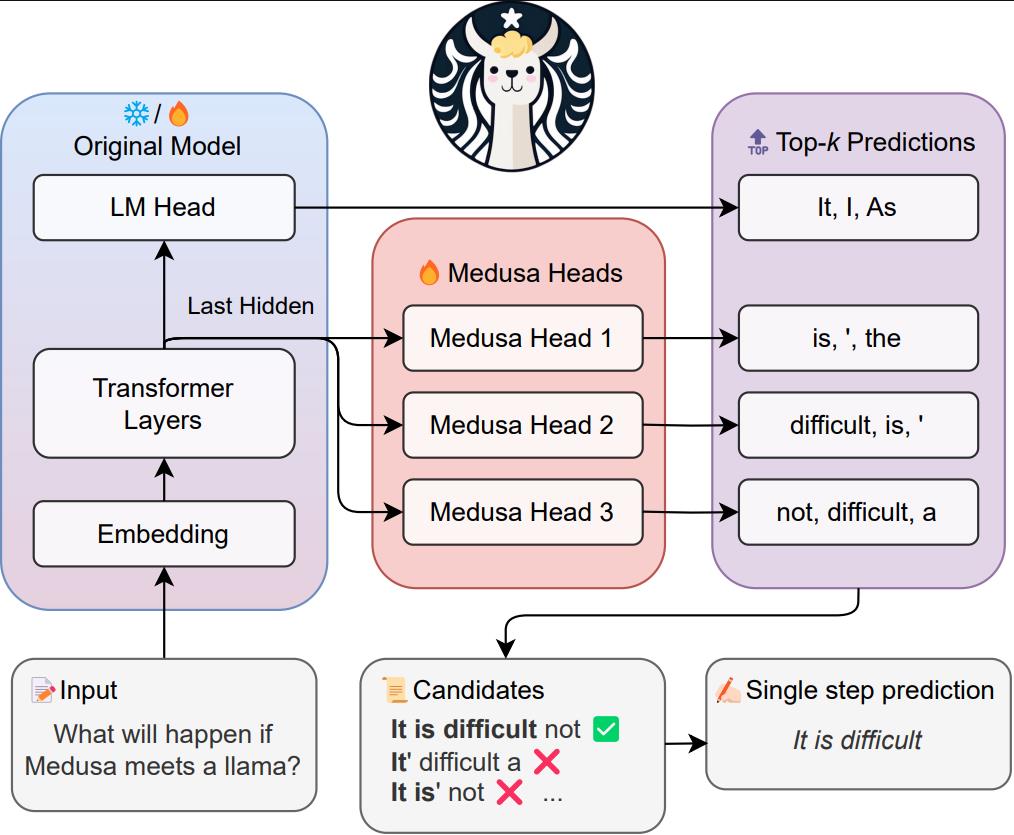
Medusa adds decoding heads on top of the target to predict several future tokens at once, then verifies the candidate tree in a single pass. No separate draft model to train or serve.
EAGLE (Li et al., arXiv 2401.15077) moves drafting to the feature level. A small head autoregresses on the target's second-to-top-layer features, conditioned on the token sequence shifted by one step to resolve feature-level uncertainty. On LLaMA2-Chat 70B it reaches 2.7x-3.5x latency speedup and doubles throughput while preserving the output distribution. EAGLE-2 (arXiv 2406.16858) replaces the static draft tree with a context-aware dynamic one, using the draft head's calibrated confidence to decide where to branch, for 3.05x-4.26x, 20%-40% over EAGLE-1. EAGLE-3 (arXiv 2503.01840) drops feature prediction for direct token prediction with multi-layer feature fusion, trained with a technique the authors call training-time test, for up to 6.5x, about 1.4x over EAGLE-2, and a 1.38x throughput gain at batch size 64 inside SGLang.
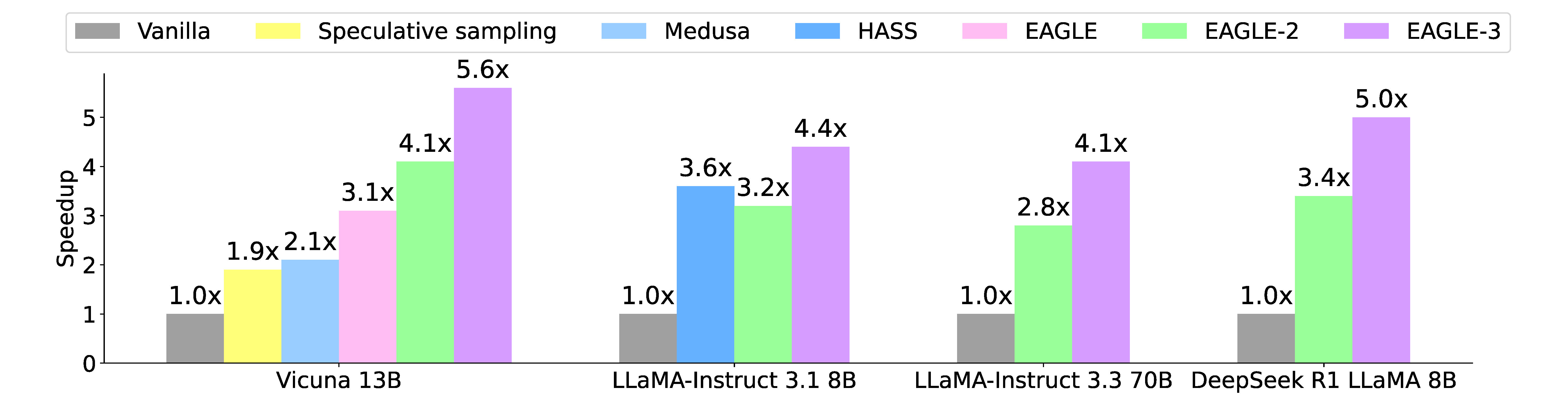
EAGLE-3 measured speedups over vanilla decoding across models and tasks. Drafting from the target's own features keeps more tokens accepted per pass, and the extra accepted length compounds into end-to-end speed.
DSpark (DeepSeek and Peking University, 2026) is the most recent shape of the idea and the one vLLM's adaptive-verification path currently targets. A parallel backbone drafts a run of tokens with confidence scores, a hardware-aware scheduler keeps the prefix likely to survive, and the target verifies only that prefix. The loop is unchanged; the scheduler decides how much of it to run. Offline it improves accepted length by 16% to 31% over the previous best drafters, and in DeepSeek's own V4 serving stack it accelerated per-user generation by 60% to 85% at matched throughput against their MTP-1 production baseline.
Speculative speculative decoding (Kumar, Dao and May, arXiv 2603.03251) attacks a different bottleneck: drafting and verification are serial, so the draft sits idle during every verify. Their Saguaro algorithm has the draft predict the verification result and start the next run before it lands, reporting on average 30% faster than optimized speculative decoding baselines and up to 5x over autoregressive decoding on open-source engines.
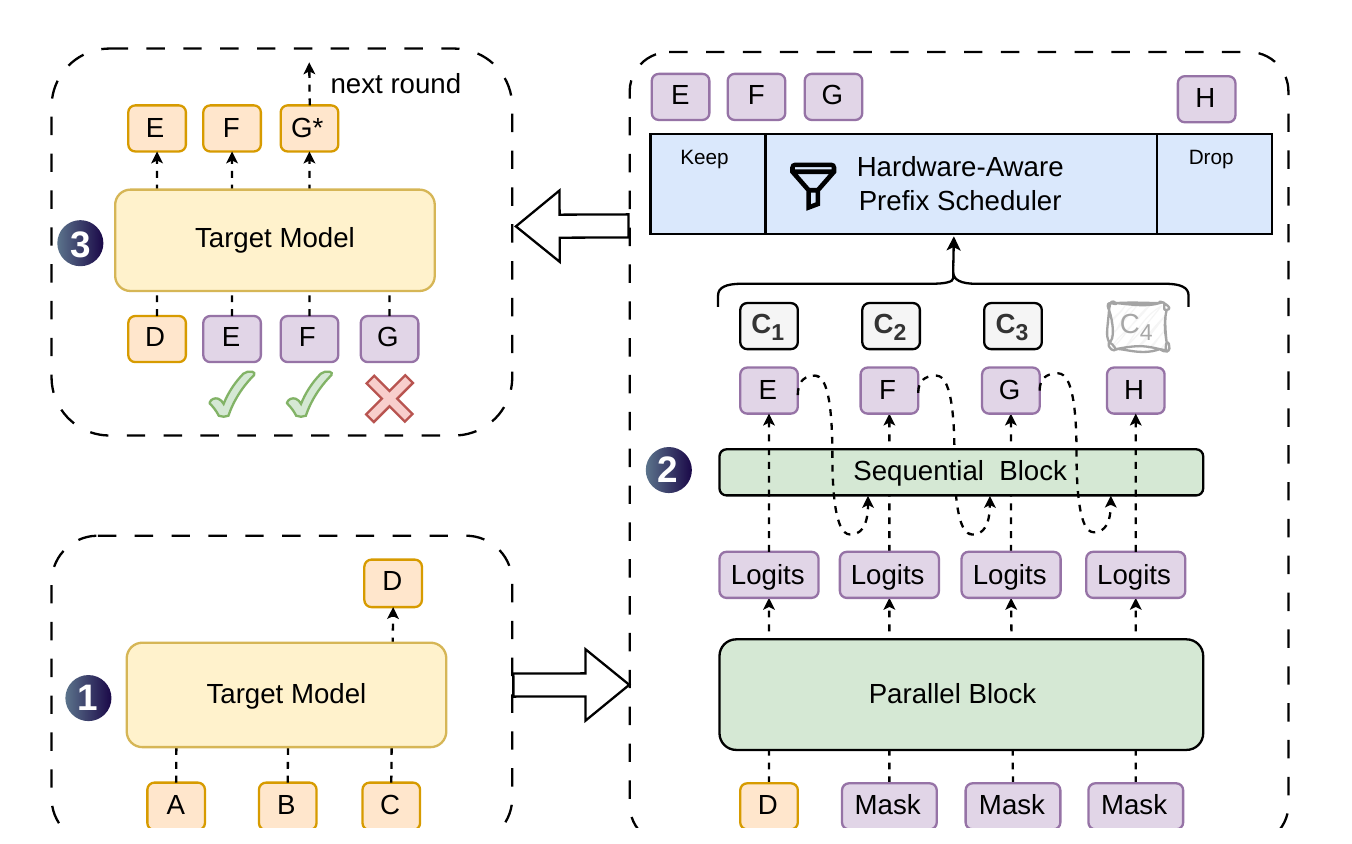
DSpark's decoding cycle. A parallel backbone plus a lightweight sequential head draft tokens E to H with confidence scores; the scheduler keeps the confident prefix (E, F, G) and drops H; the target verifies in parallel, accepting E and F and correcting G.
Published Speedups
Every number below is from the cited paper, README, or serving-framework documentation. Speedup ratios are relative to vanilla autoregressive decoding of the same target model on the same hardware.
| Method | Target / benchmark | Reported result | Source |
|---|---|---|---|
| Draft model | T5-XXL 11B, translation and summarization | 2x-3x, identical outputs; 3.4x at temp 0 | Leviathan et al. 2022 |
| Speculative sampling | Chinchilla 70B, XSum and HumanEval | 2-2.5x, no quality loss | Chen et al. 2023 |
| Bigram n-gram draft | T5-XXL, translation | α ≈ 0.2, 1.25x at γ = 3 | Leviathan et al. 2022, Sec. 3.6 |
| Medusa-1 / Medusa-2 | Models of various sizes and training procedures | Over 2.2x / 2.3-3.6x | Cai et al. 2024 |
| EAGLE | LLaMA2-Chat 70B | 2.7x-3.5x, throughput doubled | Li et al. 2024 |
| EAGLE vs Medusa vs Lookahead | 13B target | 3x vanilla, 2x Lookahead, 1.6x Medusa | EAGLE README |
| EAGLE-2 | Three model series, six tasks | 3.05x-4.26x, 20%-40% over EAGLE-1 | Li et al. 2024 (EAGLE-2) |
| EAGLE-3 | Chat and reasoning models, five tasks | Up to 6.5x; 1.4x over EAGLE-2; 1.38x throughput at batch 64 in SGLang | Li et al. 2025 (EAGLE-3) |
| SGLang EAGLE-2 / EAGLE-3 | LLaMA 3.1 8B Instruct, MT-bench, 1x H100 | 158.34 tok/s baseline; 244.10 EAGLE-2; 373.25 EAGLE-3 | SGLang docs |
| Independent: EAGLE at realistic batch | Llama-3-70B and Llama-3.1-8B on H100, batch 1 to 128 | 1.96x at batch 1; 1.21x at batch 128; tree k=21 below 1x at batch 64 | SpecDecode-Bench (Liu et al. 2025) |
| Independent: proposal-length sweep | Qwen3-8B, EAGLE-3, GSM8K and MATH500, MI300X/MI355X | 0.71x at N=1 rising to 1.18x at N=5 on GSM8K; never above 1x on MATH500 | vLLM AMD blog, Aug 2026 |
The last two rows are the ones to plan against. Every result above them was measured in the configuration that shows the method at its best, usually a single stream. The independent numbers were measured across a sweep, and they include the settings where speculation loses.
The SGLang row is the cleanest apples-to-apples measurement: same model, same GPU, same benchmark, three configurations. EAGLE-3 gives 2.36x over the baseline on that setup, which sits at the α ≈ 0.7-0.8 rows of the acceptance-rate table above.
Speculative Decoding in Production at Morph
Morph serves inference for AI coding agents, and code is the workload where speculative decoding pays off most. Two production uses illustrate the two ends of the variant table.
Fast Apply, n-gram speculation. morph-v3-fast merges an edit snippet into a file and returns the full merged file. Most output tokens already exist in the input, so a prompt-lookup draft that copies the next 64 tokens from the original file is right almost every time it fires. That is the c = 0 column of the acceptance-rate table with a high α. Combined with continuous batching and custom kernels, morph-v3-fast serves at 10,500 tok/s. The same family of tricks compresses context with Compact at 33,000 tok/s.
The independent benchmark above measured exactly when that choice is right. SpecDecode-Bench correlated speedup against BLEU-4 overlap between prompt and output, a measure of how much of the output already appears in the input. Once that overlap passes about 0.6, meaning roughly 60% of the output's 4-grams are already in the prompt, n-gram speculation beat EAGLE and EAGLE-3 at every batch size they tested, by up to 100%. Their stated takeaway: for workloads with heavy prompt-output overlap, code editing among them, n-gram is the method to use, and it needs no training. Their oracle analysis puts the ceiling for adaptively combining n-gram with EAGLE on a code-editing benchmark at 4.9x.
Open coding models, trained speculators. General chat traffic has no input to copy from, so the open models Morph serves (Kimi K3, GLM-5.3, GLM-5.3-Flash, DeepSeek V4 Flash) run with draft heads trained on coding-agent traffic. A speculator trained on the same distribution it will see in production has a higher α than a generic one, which is the "draft tuned to your workload" bar in the comparison above. On private deployments with a custom speculator, DeepSeek V4 Flash reaches up to 150 tok/s per user.
Dedicated deployments train the speculator on your traffic. See dedicated inference and the benchmark evidence behind the per-user speed numbers.
How to Enable It: vLLM and SGLang
Both major open-source serving stacks ship speculative decoding behind launch flags. The flags below are taken from the current vLLM and SGLang documentation as of 2026-09-07.
vLLM
vLLM takes a single JSON object via --speculative-config (or speculative_config= on LLM(...)). The method key selects the variant: draft_model, ngram, suffix, mtp, eagle, eagle3, or dflash. The older --speculative-model and --num-speculative-tokens flags are deprecated.
vLLM: n-gram (prompt lookup), no draft model
vllm serve <target-model> \
  --speculative-config '{
    "method": "ngram",
    "num_speculative_tokens": 4,
    "prompt_lookup_min": 2,
    "prompt_lookup_max": 5
  }'
vLLM: separate draft model
vllm serve Qwen/Qwen3-4B-Thinking-2507 \
    --speculative-config '{"model": "Qwen/Qwen3-0.6B", "num_speculative_tokens": 5, "method": "draft_model"}'
vLLM: EAGLE-3 draft head (Python)
from vllm import LLM

llm = LLM(
    model="meta-llama/Meta-Llama-3-8B-Instruct",
    tensor_parallel_size=2,
    speculative_config={
        "model": "RedHatAI/Llama-3.1-8B-Instruct-speculator.eagle3",
        "draft_tensor_parallel_size": 2,
        "num_speculative_tokens": 2,
        "method": "eagle3",
    },
)
SGLang
SGLang selects the variant with --speculative-algorithm: EAGLE (EAGLE-2), EAGLE3, NEXTN (MTP heads, an alias of EAGLE), STANDALONE (a separate draft model), NGRAM, or DFLASH. Model-based variants take --speculative-draft-model-path. Three flags shape the draft tree: --speculative-num-steps (drafting depth), --speculative-eagle-topk (branching per step), and --speculative-num-draft-tokens (how many candidates the target verifies).
SGLang: EAGLE-2 draft head
python3 -m sglang.launch_server \
    --model meta-llama/Llama-2-7b-chat-hf \
    --speculative-algorithm EAGLE \
    --speculative-draft-model-path lmsys/sglang-EAGLE-llama2-chat-7B \
    --speculative-num-steps 3 \
    --speculative-eagle-topk 4 \
    --speculative-num-draft-tokens 16 \
    --mem-fraction-static 0.7 \
--cuda-graph-max-bs-decode 8Start with the documented defaults, then measure. vLLM's tuning guidance names the signal that actually decides the setting: per-position acceptance. If the first few draft positions are accepted often and later ones are not, cut num_speculative_tokens. Their published sweep shows why. On one Qwen3-8B run, position 1 was accepted 86% of the time and position 7 only 19%, and throughput peaked at five draft tokens and fell from there. Mean accepted length alone will mislead you: it kept climbing, from 3.86 to 4.25, while throughput went down.
Do not carry a configuration between models in the same family. The same sweep found DFlash peaking at N=7 on Qwen3.6-35B-A3B and a Qwen3.6-27B run going 1.38x at N=3, 1.05x at N=7, and 0.95x at N=15 as its acceptance rate fell from 76.3% to 17.9%.
Production Gotchas Practitioners Report
The papers report speedups on clean benchmarks. The issue trackers of vLLM, SGLang, and llama.cpp report what happens when the same methods meet chat templates, quantization, and real context lengths. These four come up repeatedly and none of them appear in the vendor documentation.
| Gotcha | Symptom you will see | Reported numbers | Source |
|---|---|---|---|
| Chat template lowers MTP acceptance | Acceptance drops once you serve through the chat template instead of raw completions | ~83% at one draft token on chat data vs ~90% on pretraining-like text | ROCm/ATOM #609 |
| Context length collapses acceptance | A specific --ctx-size tanks acceptance; a nearby one is fine | ctx 12032: 16% acceptance, 1.12x. ctx 12288: 71%, 1.91x. Recurs near 2048-aligned boundaries | ggml-org/llama.cpp #23658 |
| Overhead at high concurrency | Speculation on, throughput down, time to first token up | At concurrency 256: 12%-25% throughput penalty vs no speculation, TTFT p50 about 6x | vllm-project/vllm #48494 |
| Vendor speedups do not reproduce | Your measured speedup is a fraction of the published one | 1.4x at batch size 1 against a published 2.8x, on Llama-3-70B with a 0.5B draft | vllm-project/vllm #10318 |
Chat templates and frozen MTP heads
A model's built-in multi-token-prediction head is often trained during pretraining and then frozen through supervised fine-tuning and RLHF. The main model learns the chat format. The MTP head never sees it. Role markers and thinking tags become high-entropy positions the draft has no signal for, and acceptance falls: roughly 83% at one draft token on chat-formatted data against about 90% reported on pretraining-like text (ROCm/ATOM #609). The analysis names three fixes: retrain the MTP head on chat-formatted data, cut the draft length to one token when serving through a template, or lower the draft length adaptively near structural boundaries.
The context size you picked can be the bug
One report on a Qwen3.6-35B-A3B quantization found MTP acceptance dropping to 16% with a 1.12x speedup at --ctx-size 12032, then recovering to 71% and 1.91x at 12288. The collapse recurred near 2048-aligned values, including one context length where acceptance hit zero, and was traced to how the draft context shares KV-cache slots with the target (ggml-org/llama.cpp #23658). If acceptance looks wrong, sweep the context size before you blame the draft.
Relaxed acceptance thresholds are not lossless
SGLang exposes --speculative-accept-threshold-single, shipped at 1.0, where verification matches the target exactly (measured in the NeurIPS tutorial). Lowering it accepts draft tokens the rejection rule would have thrown out, which buys speed by giving up the guarantee. Benchmarking 1.0 down to 0.4 on a frontend-design task at temperature 1 accepted visibly more drift. At temperature 0 the threshold changed nothing and every setting returned byte-identical pages. If you have relaxed this flag, none of the losslessness claims on this page apply to your deployment.
When It Does Not Help
Speculative decoding adds draft work to every step. That work is repaid only when the target accepts enough tokens. Three conditions push α down far enough that the system can end up slower than plain decoding.
Low acceptance rate
A draft that disagrees with the target wastes its proposals. Hugging Face's assisted-generation analysis names poor assistant quality and out-of-distribution inputs as the causes. Speedup favors input-grounded tasks: summarization, translation, ASR, code editing.
High sampling temperature
A hotter target is less predictable, so fewer draft tokens survive. Leviathan et al. measured 3.4x at temperature 0 against 2.6x at temperature 1 on the same T5-XXL translation task.
Draft too expensive
The cost coefficient c multiplies gamma in the denominator. Hugging Face recommends an assistant at least an order of magnitude smaller than the target. A draft that is not much cheaper than the target cannot pay for itself even at high acceptance.
Batch size matters too, and this is where the published numbers and the deployed numbers diverge most. The memory-bound argument is strongest at low concurrency, where one forward pass serves one token. As the batch fills, the GPU becomes compute-bound and the spare capacity that verification borrows shrinks. vLLM's documentation frames speculative decoding as reducing inter-token latency under medium-to-low QPS, memory-bound workloads, and grades n-gram and suffix decoding as the methods that add the least load at peak traffic.
The most complete public measurement of the crossover is SpecDecode-Bench, a systematic evaluation of five speculative methods on vLLM across four models and batch sizes from 1 to 128 on H100s, by Liu, Yu, Park, Stoica and Cheung. Their summary is worth quoting in full: speculation always helps, but expect a lower speedup in realistic batch settings, not the 3x-4x numbers often cited at batch size 1. EAGLE reached 1.96x on Llama-3-70B at batch size 1 and 1.21x on Llama-3.1-8B at batch size 128. The degradation scales with model size: going from batch 1 to batch 32 on ShareGPT cost 4.3% of the speedup on the 8B model and 14.0% on the 70B, which is already compute-bound on four GPUs at small batch.
| Setting | Speedup | Note |
|---|---|---|
| EAGLE, Llama-3-70B, batch 1 | 1.96x | The regime the headline numbers come from |
| EAGLE, Llama-3.1-8B, GSM8K, batch 128 | 1.21x | The regime most production serving runs in |
| EAGLE tree k=21, batch 64 | Below 1x | On all workloads: wasted verification of rejected branches |
| n-gram + EAGLE oracle, InstructCoder | 4.9x | Theoretical ceiling on code editing, not yet achieved |
Two production reports put the same number on it from different directions. IBM, running speculators in an internal production environment with thousands of daily users, reported roughly 2x on 7B-13B language models and 3x on their 20B code model, and stated plainly that they begin to observe throughput reduction beyond a batch size of 64. A vLLM issue measured the far side of that: at client concurrency 256, dynamic speculative decoding cost a 12% to 25% throughput penalty against no speculation and inflated median time to first token roughly 6x, and the penalty persisted even with a configuration that produced almost no draft tokens, which places the cost in the speculative path itself rather than in wasted drafts (vllm-project/vllm #48494). EAGLE-3's 1.38x throughput gain at batch size 64 shows the effect does not vanish at scale, but it is far smaller than the single-stream 6.5x.
Expect to reproduce a fraction of any headline number on your own setup. One reporter running Llama-3-70B at tensor parallel 4 with a 0.5B draft and four speculative tokens measured a maximum of 1.4x, at batch size 1, against the 2.8x in the vendor blog post they were following. The issue was closed as stale with no maintainer reply (vllm-project/vllm #10318). Published speedups are measured at the concurrency, sequence length, and draft pairing that flatter them.
On a mixture-of-experts model, batch size 1 is the worst case, not the best
The classic advice, speculate at low concurrency because that is where the GPU is idle, was derived on dense transformers. Fergus Finn worked the roofline for a modern MoE model and found the intuition partly inverted. In a dense feedforward layer, a speculated token rides weights that are already loaded, so it is close to free. In an MoE layer, extra tokens route to experts that are not resident yet, so they pay to bring those experts in. Modeling DeepSeek-V4-Flash, he puts the marginal cost of a speculated token at roughly 0.85 of full price at batch size 1, falling toward free only once the batch passes the point where the experts are already resident, around 43 tokens for that routing configuration.
Two consequences follow, and they cut in opposite directions from the dense case. There is a low-batch region where the optimal draft length is zero and you are better off not speculating at all. And the memory-bound stretch where speculated tokens are roughly free is wider for an MoE model than a dense one, so the useful batch range sits higher than the classic advice suggests. Compressed attention narrows it again from the other side: with multi-head latent attention, the first speculated token can already push the attention kernel compute-bound. If you serve MoE models, the batch size at which speculation earns its keep is a number to measure on your own stack, not to inherit from a paper on Llama.
For the other levers that stack with speculative decoding, see LLM inference optimization, continuous batching, and FP8 quantization. Quantization cuts the bytes moved per pass; speculation cuts the number of passes; batching fills the pass with more sequences. They multiply.
Frequently Asked Questions
What is speculative decoding?
An inference algorithm that samples from an autoregressive LLM faster without changing its outputs. A cheap draft proposes K candidate tokens. The target model verifies all K in a single forward pass, which on a memory-bound GPU costs about the same as generating one token. Every accepted token is nearly free. Leviathan et al. measured 2x-3x on T5-XXL with identical outputs.
Does speculative decoding change output quality?
No. Modified rejection sampling provably preserves the target's output distribution within hardware numerics. Leviathan et al. reported identical outputs on T5-XXL at 2x-3x; Chen et al. reported 2-2.5x on Chinchilla 70B without compromising sample quality. No retraining or architecture change to the target is needed.
How much speedup does speculative decoding give?
Theorem 3.8 of Leviathan et al.: (1 - αγ+1) / ((1 - α)(γc + 1)). With a free draft, α = 0.8 and γ = 5 gives 3.69x; α = 0.9 and γ = 10 gives 6.86x. Published: 2x-3x on T5-XXL, 2-2.5x on Chinchilla 70B, 2.7x-3.5x for EAGLE on LLaMA2-Chat 70B, 3.05x-4.26x for EAGLE-2, up to 6.5x for EAGLE-3.
What is the difference between a draft model, Medusa, and EAGLE?
A draft model is a separate smaller model; no training, but a second model to serve. Medusa adds decoding heads to the target and verifies with tree attention (Medusa-1 over 2.2x, Medusa-2 2.3-3.6x). EAGLE trains a one-layer head that drafts from the target's internal features (2.7x-3.5x on LLaMA2-Chat 70B; EAGLE-2 3.05x-4.26x; EAGLE-3 up to 6.5x). The EAGLE README reports EAGLE-1 at 3x vanilla, 2x Lookahead, and 1.6x Medusa on a 13B model.
What is acceptance rate in speculative decoding?
The fraction of draft tokens the target keeps during verification. It is the lever that sets the ceiling: no draft length beats 1/(1 - α), so a draft accepted 70% of the time tops out at 3.3x. Engines usually report the related mean accepted length, the tokens produced per target forward pass. Two cautions. The number is not comparable across frameworks, and high acceptance means the draft agrees with the target, not that the output is good.
What is MTP speculative decoding?
Multi-token prediction. Prediction heads trained into the base model itself, as in the DeepSeek V3 line, so the checkpoint ships with its own draft and there is no second model to load. vLLM exposes it as method: mtp and SGLang as --speculative-algorithm NEXTN. The common gotcha: an MTP head is often frozen after pretraining, so it never learns the chat template, and serving through one lowers acceptance to about 83% at one draft token against roughly 90% on pretraining-like text.
Is speculative decoding really lossless?
In distribution, yes. Byte for byte, not necessarily. vLLM's documentation states that output stability is not promised and that theoretical losslessness holds only up to hardware numerics. Measured: the same Qwen3-8B served greedily with and without a draft produced identical text for 8,299 characters, then split on one near-tie token, because the speculative path runs different kernels. Quantized targets widen the effect. Relaxing an engine's acceptance threshold below 1.0 gives up the guarantee outright.
How do I enable speculative decoding in vLLM or SGLang?
vLLM: pass a JSON object to --speculative-config with method (draft_model, ngram, eagle, eagle3, mtp, suffix), an optional model, and num_speculative_tokens. SGLang: --speculative-algorithm (EAGLE, EAGLE3, NEXTN, STANDALONE, NGRAM) with --speculative-draft-model-path and the --speculative-num-steps, --speculative-eagle-topk, --speculative-num-draft-tokens tree flags. Full commands in the section above.
Does speculative decoding still help at high batch size?
Less, and past a point not at all. Speculation borrows the idle compute that exists while decoding is memory-bandwidth-bound, and a full batch removes it. Independent benchmarking measured EAGLE at 1.96x on Llama-3-70B at batch size 1 falling to 1.21x at batch size 128, with a 21-token draft tree dropping below 1x on every workload by batch 64. Mixture-of-experts targets invert part of this: there a speculated token costs the most at batch size 1, because it routes to experts that are not resident yet.
When does speculative decoding not help?
When α is low: a poor or out-of-distribution draft, high sampling temperature, or a draft that is not much cheaper than the target. Leviathan et al. measured 3.4x at temperature 0 versus 2.6x at temperature 1 on the same task. Hugging Face recommends an assistant at least an order of magnitude smaller than the target and input-grounded tasks.
How does Morph use speculative decoding?
morph-v3-fast merges code edits with n-gram prompt-lookup speculation over a 64-token draft window and serves at 10,500 tok/s. Morph's open coding models (Kimi K3, GLM-5.3, GLM-5.3-Flash, DeepSeek V4 Flash) run speculators trained on coding traffic; DeepSeek V4 Flash reaches up to 150 tok/s on private deployments with a custom speculator.
Related Resources
The fastest endpoints are private deployments
Morph's top speeds come from dedicated deployments, not shared public endpoints: speculators trained on your traffic, caching tuned to your workload, and volume discounts over public per-token rates. Over 100 billion tokens per day run this way.
Speculative Decoding, Running in Production
Morph serves morph-v3-fast at 10,500 tok/s with n-gram speculation, and the open coding models with speculators trained on coding traffic. Lossless: output is identical to the target model. OpenAI-compatible at api.morphllm.com.
Sources
- Leviathan, Kalman, Matias. Fast Inference from Transformers via Speculative Decoding (arXiv 2211.17192) (2x-3x on T5-XXL with identical outputs; Theorem 3.8 speedup formula; Table 1 values; c < 0.05; 3.4x at temp 0 vs 2.6x at temp 1; bigram draft α ≈ 0.2, 1.25x)
- Chen et al. Accelerating Large Language Model Decoding with Speculative Sampling (arXiv 2302.01318) (2-2.5x on Chinchilla 70B, XSum and HumanEval, no quality loss)
- Cai et al. Medusa: Simple LLM Inference Acceleration Framework with Multiple Decoding Heads (arXiv 2401.10774) (Medusa-1 over 2.2x; Medusa-2 2.3-3.6x)
- Li et al. EAGLE: Speculative Sampling Requires Rethinking Feature Uncertainty (arXiv 2401.15077) (2.7x-3.5x on LLaMA2-Chat 70B, throughput doubled, distribution preserved)
- Li et al. EAGLE-2: Faster Inference of Language Models with Dynamic Draft Trees (arXiv 2406.16858) (3.05x-4.26x, 20%-40% faster than EAGLE-1)
- Li et al. EAGLE-3: Scaling up Inference Acceleration of Large Language Models via Training-Time Test (arXiv 2503.01840) (up to 6.5x, about 1.4x over EAGLE-2, 1.38x throughput at batch size 64 in SGLang)
- SafeAILab/EAGLE README (EAGLE-1 3x vanilla, 2x Lookahead, 1.6x Medusa on 13B; EAGLE-2 4x; EAGLE-3 5.6x)
- deepseek-ai/DeepSpec (DSpark) (architecture figure, confidence-aware scheduling)
- vLLM documentation: Speculative Decoding (
--speculative-configschema, method values, n-gram and draft-model examples, deprecation of--speculative-model, QPS guidance) - SGLang documentation: Speculative Decoding (
--speculative-algorithmvalues and tree flags; LLaMA 3.1 8B on 1x H100: 158.34 / 244.10 / 373.25 tok/s) - Zhang, Kanna. Speculative Decoding: How It Evolved, When It Stays Lossless, and What's Next (NeurIPS 2026 Education Track, under review) (vLLM's three layers of losslessness; greedy byte-level divergence at 8,299 chars, 10,924 vs 10,535 final; SGLang
--speculative-accept-threshold-singleat 1.0 and the 1.0 to 0.4 sweep; acceptance length 5.24 to 1.84 across five domains; frontend 54.5 to 45.5, creative writing 70 to 30, guardrail 80, agent 20.0 to 27.5; nine reported benchmarks cover 17% of OpenRouter token traffic; DSpark accepted length +16-31% offline and +60-85% per-user generation in DeepSeek V4 serving) - Liu, Yu, Park, Stoica, Cheung. Speculative Decoding: Performance or Illusion? (SpecDecode-Bench, December 2025) (five methods on vLLM, four models, batch 1 to 128 on H100: EAGLE 1.96x at batch 1 and 1.21x at batch 128; batch 1 to 32 costs 4.3% on the 8B and 14.0% on the 70B; tree k=21 below 1x at batch 64 with accepted length rising 2.25 to 2.92 while acceptance falls 0.415 to 0.095; verification 42%-95% of execution time, rejection sampling under 1.7%; n-gram beats EAGLE at every batch size once prompt-output BLEU-4 overlap exceeds ~0.6; 4.9x oracle ceiling on InstructCoder)
- vLLM: Speculative Decoding on AMD GPUs (August 2026) (proposal-length sweeps on MI300X and MI355X: Qwen3-8B with EAGLE-3 on GSM8K at 0.71x/N=1 to 1.18x/N=5 against a 3,698 tok/s baseline, per-position acceptance 86% at position 1 and 19% at position 7; the same pairing never above baseline on MATH500 despite 89.0% first-position acceptance; Qwen3.6-27B native MTP at 1.38x/N=3, 1.05x/N=7, 0.95x/N=15; per-position acceptance as the tuning signal)
- Finn. The Economics of Speculative Decoding (June 2026) (MoE roofline modeled on DeepSeek-V4-Flash: marginal cost of a speculated token about 0.85 of full price at batch size 1, approaching free once experts are resident past roughly 43 tokens; a low-batch region where the optimal draft length is zero; compressed attention can be compute-bound at the first speculated token)
- Kumar, Dao, May. Speculative Speculative Decoding (arXiv 2603.03251) (Saguaro overlaps drafting with verification; 30% average over optimized speculative decoding baselines, up to 5x over autoregressive decoding)
- PyTorch and IBM: A Hitchhiker's Guide to Speculative Decoding (2x on 7B-13B language models and 3x on a 20B code model in an internal production environment; 3-4 speculator heads for language models and 6-8 for code models; throughput reduction observed beyond batch size 64)
- Sato. Speculative Decoding Explained (survey of self-speculation and draft distillation: Draft & Verify up to 1.99x, LayerSkip up to 2.16x, DistillSpec 10%-45% over a standard draft)
- vllm-project/vllm #42508 (acceptance metrics not comparable across engines: Qwen3-32B on GSM8K, EAGLE-3 head 55.08%/2.65 in vLLM vs ~44%/2.32 in SpecForge; Qwen3-0.6B draft 66.57%/3.00 vs ~72%/3.17)
- vllm-project/vllm #48494 (concurrency 256: 12%-25% throughput penalty vs no speculation, TTFT p50 about 6x, persisting with near-zero draft tokens)
- vllm-project/vllm #10318 (published 2.8x not reproduced: Llama-3-70B TP=4 with a 0.5B draft and 4 speculative tokens measured 1.4x at batch size 1; closed as stale)
- sgl-project/sglang #21138 (acceptance pinned at exactly 0.33 with 2 draft tokens on Nemotron-3-Super-120B-A12B; throughput 14.4 to 10.9 tok/s; 63% on vLLM with the same weights)
- ggml-org/llama.cpp #23658 (MTP acceptance collapse by context size on Qwen3.6-35B-A3B: ctx 12032 gives 16% and 1.12x, ctx 12288 gives 71% and 1.91x, recurring near 2048-aligned boundaries)
- ggml-org/llama.cpp #25618 (greedy output diverges from vanilla on a Q4_K_M target with a model-based draft while n-gram matches on the same weights; bf16 target matched in 4 of 4 runs)
- ROCm/ATOM #609 (chat templates lower DeepSeek MTP acceptance because the MTP module is frozen after pretraining: ~83% at one draft token on chat data vs ~90% on pretraining-like text)
- Leviathan, Kalman, Matias. Looking back at speculative decoding (Google Research) (deployed in AI Overviews in Google Search at the same response quality; fewer machines for the same traffic)
- Hugging Face: Assisted Generation (assistant at least an order of magnitude smaller; input-grounded tasks; low temperature favorable; up to 3x with INT8, up to 2x otherwise)
- Morph: Fast Apply (morph-v3-fast at 10,500 tok/s; n-gram speculation with a 64-token draft window is Morph's production configuration)
- Morph: Fast Coding Models (custom speculators; DeepSeek V4 Flash up to 150 tok/s on private deployments)
- Morph: Compact (33,000 tok/s)