
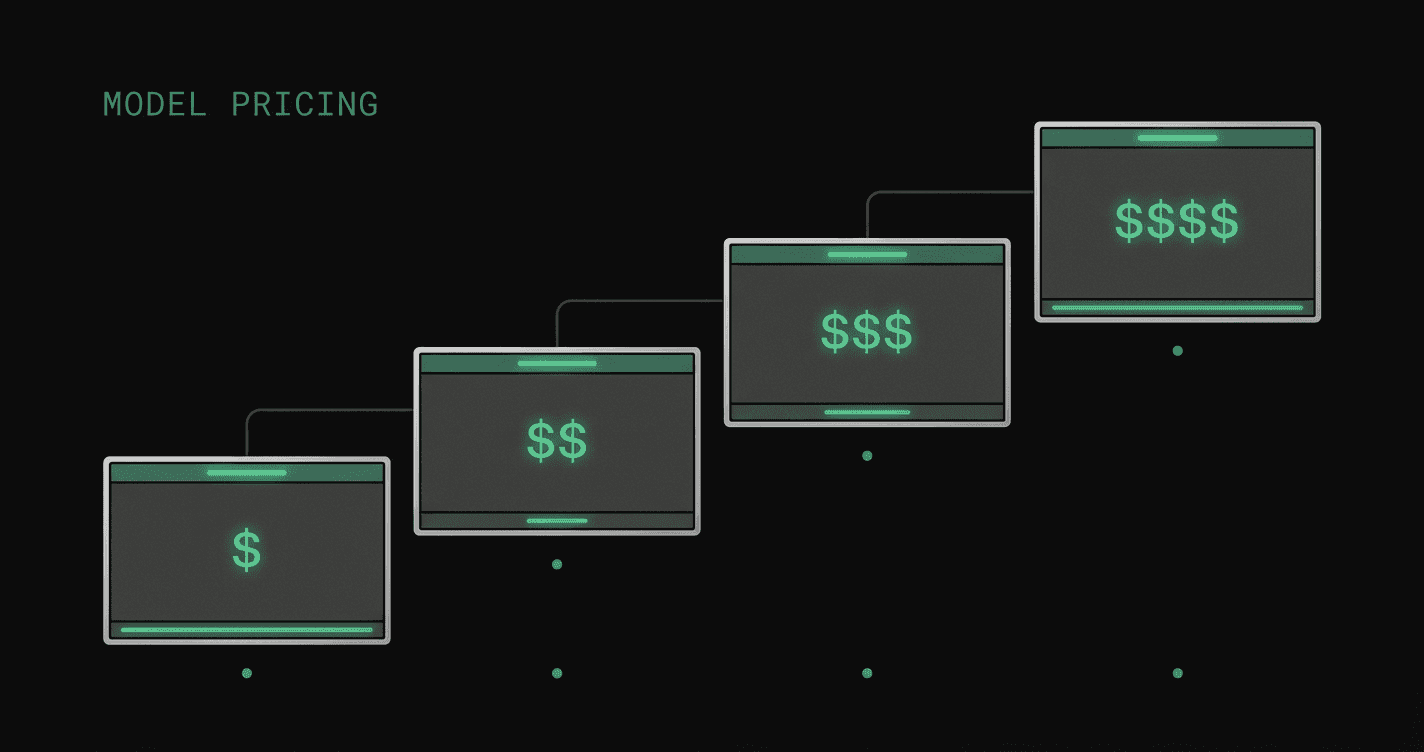
Cursor pricing looks simple: $20/month for Pro, $40/month for Business. The complication is that each AI model consumes a different number of credits per request. A developer using Claude 4 Opus burns through their monthly credit pool 5x faster than one using GPT-5.4. Max Mode accelerates this further. This page breaks down exactly what you pay for, model by model.
Cursor Plans Overview
| Plan | Price | What You Get | Best For |
|---|---|---|---|
| Hobby (Free) | $0 | 2,000 completions, 50 slow premium requests, limited models | Trying Cursor for a few days |
| Pro | $20/mo | $20 credit pool (~225 Sonnet or ~500 GPT requests), unlimited completions, Tab, background agents | Solo developers |
| Pro+ | $60/mo | 3x Pro credits, all models, priority access | Full-time agent-mode users |
| Ultra | $200/mo | 20x Pro credits, priority access, early features | All-day coding with premium models |
| Business | $40/user/mo | All Pro features + SSO, admin dashboard, usage visibility, centralized billing | Engineering teams (3+ users) |
| Enterprise | Custom | Custom limits, SLA, compliance, dedicated support | Large organizations |
The free tier is enough for a weekend evaluation. At 50 slow premium requests per month and 2,000 completions, most developers hit the wall within the first week of real use.
Pro at $20/month is where the model pricing question actually matters. Your $20 credit pool depletes at different rates depending on which models you select. That's where the confusion starts.
Model Pricing Breakdown
Cursor's credit system assigns different costs to each model. The $20 Pro credit pool does not give you a fixed number of requests. It gives you a budget that depletes based on the model's per-request cost.
| Model | Relative Credit Cost | ~Requests per $20 Pool | Notes |
|---|---|---|---|
| GPT-5.4 | 1x (base) | ~500 | Cheapest option, good for routine tasks |
| GPT-5.4-mini | 0.5x | ~1,000 | Fastest, lightest tasks only |
| Claude 4 Sonnet | ~1x | ~225 | Most popular for coding, reliable |
| Gemini 3 Pro | ~1x | ~550 | Large context window, fast |
| o3-mini | ~2x | ~250 | Reasoning model, slower |
| Claude 4 Opus | ~5-10x | ~45-90 | Best reasoning, drains credits fast |
| GPT-4.5 | ~5-10x | ~45-90 | Premium reasoning, high cost |
| Cursor Composer | Included | Unlimited (paid plans) | 4x faster, optimized for Cursor |
Cursor does not publish exact per-model credit rates. The numbers above are derived from community reports and usage tracking. Actual costs vary based on prompt length, response length, and whether features like web search or file indexing are enabled. Check Settings > Account > Usage in Cursor to see your real-time credit consumption.
The practical impact: a developer using Claude 4 Sonnet exclusively gets roughly 225 requests per month on Pro. Switch to Claude 4 Opus, and that drops to 45-90 requests. Same $20, 3-5x fewer interactions.
For teams on the Business plan ($40/user/month), this multiplies. A 10-person team using Claude 4 Opus as their default model could exhaust their collective credit pool in the first two weeks of the month.
The 20x Price Increase Controversy
In early 2025, Cursor changed the premium request cost for several models from 1x to 20x. The change was not announced prominently. Developers discovered it when their monthly quota ran out in 2-3 days instead of lasting the full month.
The most affected users were those who relied on Claude 3.5 Sonnet (the most popular coding model at the time) for daily agent-mode work. At 1x cost, 500 premium requests lasted a full month of moderate use. At 20x cost, the same workflow burned through the quota in roughly 25 requests.
Reddit threads from this period document the fallout. Users reported overage charges of $200-400 on what they expected to be a $20/month plan. The overage rate was $0.04 per premium request, and with 20x consumption, a single heavy work session could generate $50+ in overages.
Cursor has since moved to a credit-based system that provides more transparency. But the core dynamic remains: premium models cost significantly more per interaction, and the difference between a 1x model and a 10x model is not always clear when you select it from the dropdown.
Cursor now shows credit usage in the settings panel and sends alerts when you approach your limit. You can also set a hard spending cap to prevent runaway charges. If you are on the Pro plan, check Settings > Account > Usage regularly and consider switching to cheaper models for routine work.
Max Mode Costs
Max Mode is Cursor's unrestricted agent mode. It raises the tool call limit from 25 to 200 per interaction, removes context truncation, and gives you the full context window of the underlying model (up to 200K tokens for Claude). The tradeoff: it uses token-based API pricing with a 20% margin on top.
| Standard Mode | Max Mode | |
|---|---|---|
| Tool calls per interaction | 25 | 200 |
| Context handling | Truncated to ~10-15K tokens | Full model context window |
| Pricing | Deducted from credit pool | Per-token API pricing + 20% margin |
| Typical daily cost | Included in plan | $8-10/day for heavy use |
| Monthly cost (heavy use) | $20-60/month (plan price) | $180-300/month (plan + tokens) |
| Best for | Routine edits, short tasks | Complex features, multi-file refactors |
The math on Max Mode: a single complex task with 150 tool calls, 200K input tokens, and 20K output tokens costs roughly $3-8 depending on the model. Three of those per day puts you at $9-24/day, or $180-500/month on top of your subscription.
Max Mode is where Cursor bills can spike unexpectedly. Your base subscription covers standard mode usage. Max Mode charges are separate and metered. If you leave Max Mode on by default and work in agent mode all day, expect your monthly Cursor cost to reach $200-400.
Max Mode pays for itself on complex tasks that would otherwise require 3-4 standard interactions (because you hit the 25 tool-call ceiling). If a task needs 60+ tool calls and full-context reasoning, one Max Mode session is faster and often cheaper than four fragmented standard sessions. For simple edits and quick fixes, standard mode is better value.
Cost Comparison with Alternatives
Cursor is not the only option. Here is how pricing compares across the major AI coding tools in March 2026.
| Tool | Free Tier | Standard Plan | Power User Tier |
|---|---|---|---|
| Cursor | 50 slow premium requests | $20/mo (Pro) | $200/mo (Ultra) |
| Claude Code | ~15 messages/5hrs | $20/mo (Pro) | $200/mo (Max 20x) |
| GitHub Copilot | 2,000 completions + 50 chat | $10/mo (Pro) | $39/mo (Pro+) |
| Windsurf | Limited | $15/mo | $60/mo (Pro+) |
| Cline | Free + API costs | $0 (bring your API key) | API costs only |
| Tool | Team/Business | Enterprise | 10-Person Team Cost |
|---|---|---|---|
| Cursor | $40/user | Custom | $400/mo |
| Claude Code | $25-150/user | Custom (~$60+/user) | $250-1,500/mo |
| GitHub Copilot | $19/user | $39/user | $190-390/mo |
| Windsurf | $30/user | Custom | $300/mo |
| Cline | API costs only | N/A | API costs only |
Claude Code: Terminal-First Agent
$20/mo Pro or $100-200/mo Max. No per-model credit games. Uses 5.5x fewer tokens than Cursor for equivalent tasks in independent benchmarks. Subscription includes rate-limited usage across all models. API pricing available for pay-per-use.
Cline: Zero Subscription
Open-source VS Code extension. $0 subscription, you bring your own API key and pay providers directly. Full transparency on costs since you see every API call, with no credit system or hidden multipliers. Trade-off: requires API key management and cost monitoring.
The key difference: Cursor and GitHub Copilot use credit-based billing where different models drain credits at different rates. Claude Code uses rate-limited access where all models are included in your plan. Cline and open-source tools pass through raw API costs with zero markup. For developers who want predictable monthly bills, Claude Code's subscription model or Cline's direct API approach can be more transparent than Cursor's credit system.
For a deeper dive into the Cursor vs Claude Code trade-offs, see our full comparison. For a broader view, check the Cursor alternatives roundup.
How to Reduce Cursor Costs
If you want to stay on Cursor without surprise bills, these strategies help.
Use Cheaper Models for Simple Tasks
GPT-5.4-mini and Cursor's Composer model cost a fraction of Claude Opus. Use them for autocomplete, simple edits, and routine refactoring. Save premium models for complex reasoning tasks.
Disable Max Mode by Default
Max Mode is powerful but expensive. Keep it off unless you genuinely need 200 tool calls and full context. Most tasks complete fine within the 25 tool-call standard limit.
Monitor Usage Weekly
Check Settings > Account > Usage in Cursor at least weekly. Identify which models are consuming the most credits and adjust your defaults accordingly.
Set a Spending Cap
Cursor lets you set hard limits on overage spending. Set this immediately after subscribing. A $20 cap prevents the $300 surprise bills that caught early adopters.
Start Fresh Sessions Often
Long conversations accumulate context tokens. Five short sessions cost less than one long session because less context is re-sent with each message. Start a new chat when you finish a task.
Consider BYOK for Heavy Use
Cursor supports Bring Your Own Key (BYOK) for API access. If you have volume pricing or credits with Anthropic or OpenAI, BYOK can be cheaper than Cursor's markup. You lose the credit pool but gain full cost control.
FAQ
How much does Cursor cost per month?
Cursor offers Free (50 slow premium requests), Pro ($20/mo with a $20 credit pool), Pro+ ($60/mo with 3x credits), Ultra ($200/mo with 20x credits), Business ($40/user/mo), and Enterprise (custom). Actual cost depends on which models you use, since premium models consume credits 5-10x faster than base models.
Why do some Cursor models cost more than others?
Each model has different inference costs. GPT-5.4 is cheap to run, so it costs roughly 1x credits. Claude 4 Opus requires more compute, so it costs 5-10x credits per request. Cursor passes through these cost differences via its credit system. The result: your $20/month buys 500 GPT-5.4 requests or roughly 45 Claude 4 Opus requests.
What is Max Mode and how much does it cost?
Max Mode raises tool calls from 25 to 200 per interaction, removes context truncation, and uses per-token API pricing with a 20% margin. Heavy daily use costs $8-10/day, or $180-300/month on top of your subscription. It's worth it for complex tasks but expensive as a default.
What happened with Cursor's 20x price increase?
In early 2025, Cursor changed some model costs from 1x to 20x premium requests without clear notice. Users who relied on Claude 3.5 Sonnet went from 500 effective requests/month to about 25. Some reported $300+ monthly bills from overage charges. Cursor has since moved to a credit system with better transparency, but per-model cost variation remains.
How does Cursor pricing compare to Claude Code and Copilot?
All three have $20/month entry points (Copilot is $10/month). The differences: Cursor uses per-model credit billing where costs vary by model. Claude Code includes all models in your subscription at rate-limited access. Copilot is cheapest for teams ($19/user vs Cursor's $40/user). Claude Code uses 5.5x fewer tokens for identical tasks, so cost-per-result often favors Claude Code for complex work.
Related Guides
Reduce AI coding costs with Morph
WarpGrep finds relevant code in 1-2 searches instead of 20+ file reads, cutting token consumption by 70-80%. Fast Apply handles file edits at 10,500 tok/s. Works with Cursor, Claude Code, and any MCP-compatible tool.